
Fairy Tale · Interactive story
The Third Child’s Gambit: A Fairy Tale Interactive Story
Your siblings have the swords, but you have the secret that kills the dragon.
Start as a guest. Choose your character before the story begins.
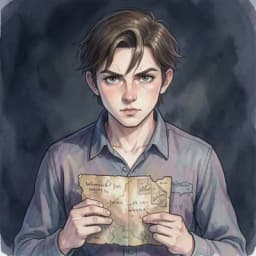
Meet the sample character
Try a scene · No signup
The Salt-Stained Map
A short sample of this world. Your own version starts with your character.
You stand on the jagged edge of the Whispering Crags, your boots slipping on loose shale. Above, the sky is a bruised violet, heavy with the promise of a storm that smells of ozone and iron. Your brothers, Hektor and Bram, are already ten paces ahead, their heavy iron swords clanking against their armor, oblivious to the way the shadows beneath the rocks are stretching, reaching toward their ankles.

“Keep up, Joram, or stay behind to feed the mountain crows. Your soft feet are slowing the entire party.”

You press your hand against the cold stone, feeling the vibration of a thousand voices trapped within the rock. Your brothers follow the path marked on the royal parchment, but you saw the ink shimmer in the lantern light—it is a map to a grave, not a garden. Bram kicks a pebble, and the entire cliffside shudders, revealing a narrow, hidden fissure that hums with a warm, golden light.
“The parchment is a lie, and if we keep following those red lines, we will be ghosts before dawn.”
The fissure pulses, a heartbeat of light that beckons you, while the path your brothers are taking descends into a thick, unnatural fog. Hektor turns, his hand on his sword hilt, his eyes narrow with irritation at your defiance. You have one breath to choose your path before the mountain decides for you.
Do you follow your brothers into the fog, step into the golden fissure, or attempt to confront them with the truth of the map?
Your character. Your next move.
Outsmart the legends and claim your crown.
The kingdom expects your brothers to return as heroes, but the woods have other plans. Will you walk into the dragon’s lair, or will you find the back door? The path you choose defines whether you remain a servant at the hearth or become the ruler of the realm. Every decision counts.
Start your legend nowYour Story, Your Way
Everything is customizable. Pick any genre, setting, or character — the AI builds a world around exactly what you want.
Any Character
Design your appearance, personality, backstory — every detail
Any World
Fantasy kingdoms, sci-fi stations, modern cities — you choose
Branching Paths
No two playthroughs are the same. Your choices reshape everything
Full Immersion
AI images, voice acting, sound effects — a living story
Negotiate with a bridge-dwelling hag by offering a secret instead of a bribe.
Choose to sabotage your brother’s armor to ensure he fails the dangerous quest.
Master the art of deception to infiltrate the royal banquet disguised as a servant.
Decide whether to release a trapped forest spirit in exchange for magical insight.
The king’s decree rings through the village: whoever retrieves the golden thread from the Whisper-Wood will inherit the crown. Your brothers—Hakon with his heavy iron shield and Bram with his tempered broadsword—have already left, their armor clanking like thunder. You, left behind to scrub the hearth, know something they do not. The thread isn't guarded by fire or steel, but by a riddle that changes every time the moon wanes. You pack a pouch of dried berries and a rusted needle, slipping into the trees while the forest still sleeps. This is a tale of your own making, where every choice, from the bargains you strike with forest spirits to the lies you tell the guards, leads to a different ending. You aren't the hero the kingdom expects, but you are the only one who survives the night.
What is The Clever Youngest Child in Fairy Tale?
The 'Clever Youngest Child' is a staple of folklore, appearing in foundational tales like Puss in Boots or the Russian story of Vasilisa the Beautiful. Unlike the eldest sibling, who typically relies on brute strength, inherited status, or rigid adherence to tradition, the youngest child succeeds by observing the details others ignore. They are the ones who share their crust of bread with the starving crone, or who notice the loose brick in the castle wall that hides a secret passage. Consider Puss in Boots; he is not the master of the estate, yet his cunning turns a penniless boy into a Marquess. In these stories, the youngest sibling is a deliberate disruptor. They are rarely the physically strongest, but they possess a flexible morality and a sharp eye for patterns that allow them to dismantle systems of power from the inside. When you engage with this archetype, you are stepping into the role of the outsider who understands the game better than the masters who created it.
Why play The Clever Youngest Child as an interactive story?
Agency is the defining element of this archetype. When you play, you are not merely reacting to a plot; you are actively deciding how to weaponize your perceived weakness. You will face moments where the 'obvious' path—fighting the troll or challenging the knight—is a guaranteed death. Instead, you might choose to trick the troll into a debate about philosophy, or use the knight's own vanity to lead him into a bog. Your choices determine if you are remembered as a saint or a schemer. Will you use your wits to save your arrogant siblings, or will you let them stumble into their own traps while you claim the throne? Every decision shifts the narrative, forcing you to balance your survival against your ambition.
The psychology of The Clever Youngest Child: why readers fall for this character
The appeal of the Clever Youngest Child lies in the universal satisfaction of seeing the underdog win without becoming the bully. We all know the frustration of being underestimated, and this archetype acts as a cathartic release. In the classic Hansel and Gretel, it is the youngest who recognizes the trap of the gingerbread house and turns the witch’s fire against her. In J.R.R. Tolkien’s The Hobbit, Bilbo Baggins—the smallest and most overlooked member of the company—is the one who navigates the riddles of Gollum and steals the key from the dragon. These characters are not motivated by glory, but by survival and a wry sense of justice. They prove that power is not just a matter of who holds the sharpest blade, but who understands the rules of the world well enough to bend them. While the eldest siblings represent the established order, the youngest child represents the necessity of change. They are the chaos element that keeps the fairy tale world spinning. By playing this role, you tap into the fantasy of intelligence outperforming raw force, proving that the smallest contender often holds the keys to the kingdom.
FAQ
What is the role of the youngest child in folklore?
They serve as the catalyst for change, using wit, empathy, and observation to bypass obstacles that defeat their stronger, more arrogant siblings.
How do my choices change the story?
Every conversation and action affects your standing with NPCs, opening new paths or closing doors based on your reputation for cunning or kindness.
Is this story game suitable for fans of dark fairy tales?
Yes, the tone is grounded in classic, often brutal, fable tradition, allowing for both whimsical successes and grim, high-stakes failures.
Can I play as a villainous youngest child?
Absolutely. You decide if your cunning is used to protect your family or to secure your own rise to power at their expense.
Explore more Fairy Tale stories like Cursed Princess, Beast Transformation, Wicked Stepmother.
More Fairy Tale Stories
Cursed Princess
A terrible curse transforms the princess into something monstrous, and the kingdom has given up hope. Only your choices can unravel the enchantment and reveal whether breaking the curse requires sacrifice, love, or something no one expects.
TropeBeast Transformation
A handsome prince trapped in a monstrous form, a curse that only deepens with time — your compassion and choices determine whether the beast within is tamed or unleashed forever.
TropeWicked Stepmother
She smiles sweetly while plotting your ruin, and no one believes she is anything but kind. Outsmart the wicked stepmother whose cruelty hides behind a mask of maternal concern in a tale where survival depends on your wits.
TropeFairy Godmother Twist
Your fairy godmother arrives with a wave of her wand, but her gifts come with conditions you did not read in the fine print. Discover that magical help always has a price in a story where wishes are never quite what they seem.
TropeEnchanted Sleep
A magical slumber descends, and the whole kingdom falls silent. Race against time to find the cure before the spell becomes permanent, choosing between dangerous shortcuts and the longer path that might save everyone.
TropeImpossible Tasks
Sort a mountain of grain by dawn, spin straw into gold, or fetch water from the edge of the world. You are given tasks that seem impossible, but cleverness, unexpected allies, and bold choices can achieve the unachievable.