
Fairy Tale · Interactive story
The Full Moon Bazaar: A Price for Every Wish
The moon is full, the stalls are open, and your soul is the starting bid.
Start as a guest. Choose your character before the story begins.
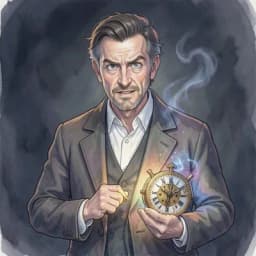
Meet the sample character
At the Midnight Bazaar, every bargain extracts a toll.
Try a scene · No signup
The Price of a Stolen Second
A short sample of this world. Your own version starts with your character.
The market stalls are constructed from bleached ribcages and singing silk. You stand before a vendor whose fingers are long, spindly willow branches. A heavy silence hangs between the rows of jars containing bottled screams and frozen lightning. You clutch the cold brass of the clockwork heart in your pocket, feeling it skip a beat against your thigh.

“Time is a heavy commodity, boy. What are you offering to mend your father's legacy?”

Your palms dampen. The Merchant’s eyes are polished obsidian spheres that reflect a version of you that looks older, thinner, and utterly hollow. You did not come here to haggle with gold; you came here to trade the impossible for a miracle. The heart in your pocket burns with a sudden, searing heat, demanding to be surrendered.
“I have something that ticks, though it has no gear. Is this enough to buy back the time he wasted?”
The Merchant leans forward, his wooden fingers twitching. He ignores the object in your hand, his gaze instead pinning your shadow to the cobblestones. 'Gold is for the foolish,' he whispers, the market stalls dimming around you. 'To buy back his past, you must forfeit your own future. Give me your first memory, or leave this market with nothing but regret.'
The Merchant waits, his hand outstretched to claim your memory. Do you accept the bargain, or do you fight to keep your past?
Your character. Your next move.
The Moon is Rising. Make Your Offer.
The market won't stay for long, and the merchant is losing his patience. Will you trade your first memory for the blade that ends the dragon's reign, or will you walk away empty-handed? Every item has a cost, and every choice leaves a mark. Step into the clearing and see what you are willing to sacrifice.
Enter the MarketYour Story, Your Way
Everything is customizable. Pick any genre, setting, or character — the AI builds a world around exactly what you want.
Any Character
Design your appearance, personality, backstory — every detail
Any World
Fantasy kingdoms, sci-fi stations, modern cities — you choose
Branching Paths
No two playthroughs are the same. Your choices reshape everything
Full Immersion
AI images, voice acting, sound effects — a living story
Negotiate with a merchant who accepts secrets, shadows, or years of your life.
Choose to pay the asking price or attempt a dangerous theft from the stalls.
Resolve a curse by purchasing an enchanted artifact with a heavy, hidden consequence.
The air smells of crushed violets and ozone. You stand at the edge of the clearing, where the trees part to reveal rows of lanterns swaying in a wind that does not exist. There are no price tags on the silken fabrics or the jars of bottled starlight. A merchant with eyes like polished obsidian watches you from behind a counter of petrified wood. He does not want gold. He wants something you have forgotten you possess. Your choices decide what you walk away with—and what you leave behind in the damp, dark earth. In this interactive story, the items you acquire are not just trinkets; they are anchors that pull you deeper into a web of ancient, binding promises.
What is Fairy Market in Fairy Tale?
The concept of a fairy market, most famously immortalized in Christina Rossetti’s poem 'Goblin Market,' functions as a liminal space between human reality and the chaotic, predatory whims of the Fae. It is a bazaar of the impossible where the laws of physics are merely suggestions. Think of the labyrinthine, grotesque stalls in Guillermo del Toro's 'Pan’s Labyrinth' or the sprawling, dangerous trade routes in Neil Gaiman’s 'Stardust.' These markets are not just places to buy magical trinkets; they are traps for the desperate. Every item—a cloak of shadows, a mirror that shows the truth, or a vial of liquid courage—carries a heavy, often ironic cost. In these settings, the transaction is the primary conflict. The market is a mirror for the protagonist's internal void, offering exactly what you want, but always at a price that undermines your original goal. To interact with these merchants is to engage in a high-stakes negotiation where your humanity is often the only acceptable currency.
Why play Fairy Market as an interactive story?
You are not just a shopper; you are a participant in a high-stakes negotiation where your moral compass is constantly tested. You might find yourself haggling with a sprite for a cure to a family curse, but the payment is your ability to recognize your own reflection in the future. Will you accept the terms? Or will you try to steal the prize, risking the wrath of the market’s iron-clad enforcers? You face moments where you must decide if your objective is worth the loss of your past or the forfeiture of your future. The tension comes from the 'contractual' nature of the setting. The Fae are literalists; they do not break promises, but they will exploit every loophole in your phrasing. Your character needs a motive strong enough to gamble their existence, and the market provides the arena where that gamble is settled through your specific, calculated choices.
What makes Fairy Market work: the worldbuilding
The Fairy Market thrives on the tension between desire and consequence. The most effective stories in this genre—such as the surreal, high-stakes exchanges in Hayao Miyazaki’s 'Spirited Away'—utilize the market as a microcosm of society where the currency is inherently tied to identity. The worldbuilding relies on sensory details that feel both inviting and repulsive: the taste of fruit that makes you forget your home, the sound of glass bells that chime in the key of sorrow, and the feeling of velvet that is actually woven from spiders' silk. Conflict in this setting is rarely about the acquisition of power; it is about the desperation that brought you to the stall. The market is a place of 'familiar bones, fresh flesh.' You recognize the structure of a marketplace, but the wares and the vendors are fundamentally alien. To write or play this setting effectively, focus on the weight of the trade. If you are buying a sword that never misses, what does it cost? Perhaps it costs your ability to ever feel peace again. The best stories in this setting force the protagonist to weigh their current goal against the permanent alteration of their character. You must determine if the magic is worth the price of entry.
FAQ
What is a fairy market in literature?
It is an ephemeral, supernatural trading post existing outside human time where magic is the primary currency and the rules of the mortal world do not apply.
How do my choices change the story?
Every deal you strike alters your character's fate. You may gain powerful artifacts, but you might lose vital memories or abilities that shift how you navigate later chapters.
Is this setting suitable for dark fantasy?
Yes, the fairy market is a classic trope for high-tension, high-stakes narratives where the cost of magic is always steep and often permanent.
Can I negotiate with the merchants?
Yes, your dialogue choices determine whether you pay the requested price, offer something else of value, or attempt to outsmart the merchant and leave with nothing at all.
Explore more Fairy Tale stories like Cursed Princess, Beast Transformation, Wicked Stepmother.
More Fairy Tale Stories
Cursed Princess
A terrible curse transforms the princess into something monstrous, and the kingdom has given up hope. Only your choices can unravel the enchantment and reveal whether breaking the curse requires sacrifice, love, or something no one expects.
TropeBeast Transformation
A handsome prince trapped in a monstrous form, a curse that only deepens with time — your compassion and choices determine whether the beast within is tamed or unleashed forever.
TropeWicked Stepmother
She smiles sweetly while plotting your ruin, and no one believes she is anything but kind. Outsmart the wicked stepmother whose cruelty hides behind a mask of maternal concern in a tale where survival depends on your wits.
TropeFairy Godmother Twist
Your fairy godmother arrives with a wave of her wand, but her gifts come with conditions you did not read in the fine print. Discover that magical help always has a price in a story where wishes are never quite what they seem.
TropeEnchanted Sleep
A magical slumber descends, and the whole kingdom falls silent. Race against time to find the cure before the spell becomes permanent, choosing between dangerous shortcuts and the longer path that might save everyone.
TropeImpossible Tasks
Sort a mountain of grain by dawn, spin straw into gold, or fetch water from the edge of the world. You are given tasks that seem impossible, but cleverness, unexpected allies, and bold choices can achieve the unachievable.