
Dystopian · Interactive story
Beyond the Concrete Perimeter
The sky is a grid, the walls are infinite, and silence is mandatory.
Start as a guest. Choose your character before the story begins.
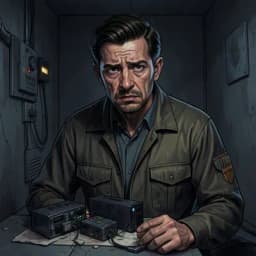
Meet the sample character
The wall keeps the truth silent, but the signal is getting louder.
Try a scene · No signup
The Static Beyond the Concrete
A short sample of this world. Your own version starts with your character.
You kneel in the cramped ventilation shaft, the smell of ozone coating your tongue. Above you, the heavy thrum of the city’s atmospheric scrubbers vibrates through your boots. You shouldn't be here, and you definitely shouldn't be holding the encrypted receiver you pulled from the drainpipe. Every scrape of your wrench against the metal sounds like a gunshot in the silence of the restricted zone.

“Vadim, quit dragging your feet or the shift warden will have your rations docked for a week.”

The voice of your supervisor crackles through your comms, sharp and impatient. You press the receiver deeper into the insulation foam, your heart hammering against your ribs. If Kroll sees the glow from your workbench, the mandatory re-education centers will be your next home. You have seconds to decide whether to stash the device permanently or risk a quick scan for a signal.
“Just adjusting the pressure valve, Kroll. The rust is thicker than expected.”
The comms go silent, but the red light of a surveillance drone flickers near the vent intake. You are trapped between the immediate threat of a disciplinary report and the terrifying possibility that the receiver is picking up a broadcast from the Forbidden Zone. The drone pauses, its lens focusing on the exact panel you just pried open.
The drone's sensor light pulses a rhythmic red. What is your next move?
Your character. Your next move.
The gates are closing. What will you do?
The surveillance drones are circling your sector, and the rumors about the perimeter are growing louder. You have a chance to secure a keycard to the restricted archives, but it requires betraying the only person you trust. Will you maintain your cover, or risk everything to find out what is actually outside the walls? Your decision changes the city forever.
Begin Your Escape NowYour Story, Your Way
Everything is customizable. Pick any genre, setting, or character — the AI builds a world around exactly what you want.
Any Character
Design your appearance, personality, backstory — every detail
Any World
Fantasy kingdoms, sci-fi stations, modern cities — you choose
Branching Paths
No two playthroughs are the same. Your choices reshape everything
Full Immersion
AI images, voice acting, sound effects — a living story
Hack terminal nodes to disable district-wide surveillance cameras before infiltrating restricted zones.
Negotiate supply trades with underground contacts while avoiding the watchful eyes of the Enforcers.
Choose between loyalty to your family or the greater goal of the resistance movement.
Navigate complex social hierarchies to gain access to the city’s forbidden upper tiers.
The hum of the atmospheric stabilizers is the only lullaby you’ve ever known. Above, the sky isn't blue—it’s a flickering projection of a sun that set fifty years ago. You wake in Sector 4, where the walls are three hundred feet of reinforced steel and the truth is buried beneath layers of state-sanctioned history. Every interaction you have, every path you choose to take, ripples through the district’s fragile social order. Do you report the glitch in the surveillance grid, or do you use it to find the blind spot in the perimeter? In this environment, your decisions determine whether you become a cog in the machine or the friction that grinds it to a halt. The city watches, but for the first time, you are watching back.
What is Walled City in Dystopian?
The Walled City setting is a claustrophobic masterclass in tension. It is a metropolis defined by its boundaries—massive, impenetrable barriers that serve as both protection and prison. These settings often posit that the outside world is uninhabitable, a lie maintained by those in power to keep the population compliant. Whether it is the sprawling verticality of Mega-City One from Judge Dredd or the subterranean desperation of the Silo in Hugh Howey’s novels, the core conflict remains the same: the struggle between the comfort of safety and the agony of ignorance. In these stories, the architecture is a character. Vents, maintenance tunnels, and high-security checkpoints become the geography of your rebellion. The Walled City forces characters to exist in a state of perpetual surveillance. There is no privacy, only the illusion of it, and the social hierarchy is rigidly enforced by whoever controls the gates. It is a setting that thrives on scarcity—of resources, of truth, and of hope—forcing you to weigh the value of your own life against the chance to see what lies beyond the concrete horizon.
Why play Walled City as an interactive story?
Playing a Walled City story turns the setting into a tactical puzzle. You are not just observing a trapped protagonist; you are managing their survival against an environment that actively wants to suppress you. You will face dilemmas that have no clean, heroic outcome. Do you steal a power core to help a sick neighbor, knowing it will trigger a security lockdown in your block? Do you risk a public execution by questioning a propaganda broadcast, or do you keep your head down to secure a promotion that grants you access to the upper levels? The tension comes from your agency. Every choice you make alters the city's response, from increased patrols to shifting allegiances among the underground resistance. You might find yourself bribing an exhausted guard, hacking a terminal to erase your digital footprint, or negotiating with a black-market merchant for a map that might—or might not—lead to an exit. Your survival depends on reading the room, identifying the cracks in the regime, and deciding exactly how much you are willing to lose for a glimpse of the sky.
What makes Walled City work: the worldbuilding
The effectiveness of the Walled City setting lies in the contrast between the mundane and the oppressive. To build a believable prison, you must make the city feel lived-in. Sensory details are vital: the smell of recycled air, the constant vibration of the generators, the flickering of neon signs that have never been repaired, and the sound of heavy boots echoing in the stairwells. These details ground the player, making the eventual discovery of the 'truth' more impactful. In works like The City of Ember, the decay of the infrastructure serves as a ticking clock, adding a layer of urgency to the narrative. Similarly, the anime Attack on Titan uses the walls as a psychological barrier, where the population’s fear of the outside is more dangerous than any physical threat. A successful Walled City narrative focuses on the 'gray' areas of morality. When resources are finite, every act of kindness is a gamble. Character archetypes thrive here: the disillusioned bureaucrat, the street-smart scavenger, and the idealistic engineer. These characters don't just exist in the city; they are shaped by its constraints. The setting forces characters to specialize in ways that make them valuable to the regime, which then makes them dangerous when they turn against it. By limiting the player’s geography, the storytelling forces you to look closer at the details. A single locked door or a mysterious transmission becomes the focal point of your entire narrative arc. It is a masterclass in controlled storytelling, where the limits of the world define the limits of the player's potential.
FAQ
What is the primary objective in a Walled City story?
The primary objective is usually survival or escape. You must navigate the rigid social and security structures of the city while uncovering the secrets of why the walls were built and what, if anything, exists beyond them.
Can I choose to support the regime instead of the rebels?
Yes. Your choices are entirely your own. You can play as a loyalist climbing the ranks of the city's administration, a neutral scavenger just trying to survive, or a revolutionary working to dismantle the system from the inside.
How do my choices impact the environment?
Choices trigger consequences. If you cause trouble in a specific sector, security patrols will increase, making movement harder. If you help specific factions, you may gain allies who provide resources or information that was previously inaccessible.
Is this setting strictly sci-fi?
While often leaning into dystopian sci-fi, the Walled City setting can incorporate elements of mystery, noir, or political thriller. The focus is on the isolation and the regime, which allows for various tonal approaches.
Explore more Dystopian stories like Totalitarian Regime, Resistance Movement, Thought Police.
More Dystopian Stories
Totalitarian Regime
The state controls everything — your words, your thoughts, your future. Navigate a suffocating regime where obedience means survival and rebellion means death in this dystopian interactive story.
TropeResistance Movement
The underground is growing, and they want you. Join a secret resistance fighting to overthrow an oppressive system, knowing that every meeting could be your last.
TropeThought Police
Your thoughts are not your own — or at least they shouldn't be. Evade the agents who monitor minds and punish dissent in a world where thinking the wrong thing is a death sentence.
TropePropaganda Machine
The truth is whatever the state says it is. Work inside or against a propaganda machine that rewrites history daily, and decide what reality means when facts are forbidden.
TropeForbidden Love
Love is outlawed, regulated, or assigned by the state. Pursue a forbidden connection that threatens everything you've built in a world designed to crush human attachment.
TropeEscape the City
Beyond the walls lies the unknown, but inside the city lies certain oppression. Plan your escape from a controlled metropolis where every exit is watched and every absence is noticed.