
Dystopian · Interactive story
The Price of a Perfect World
Smile for the cameras, or face the consequences of your own dissatisfaction.
Start as a guest. Choose your character before the story begins.
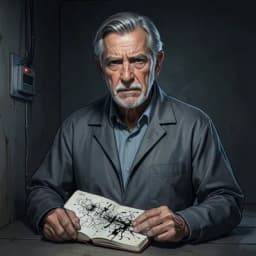
Meet the sample character
The only crime is silence.
Try a scene · No signup
The White Room Compliance
A short sample of this world. Your own version starts with your character.
You stand in the observation hub, the hum of the air recyclers vibrating in your teeth. Below, the plaza is a sea of synchronized white tunics. Everyone is smiling—the mandatory expression for the mid-day cycle. Your scanner blips: a heart rate spike in the blue sector.

“Koji, that sector is your responsibility. Why hasn't the sedative drone been dispatched yet?”
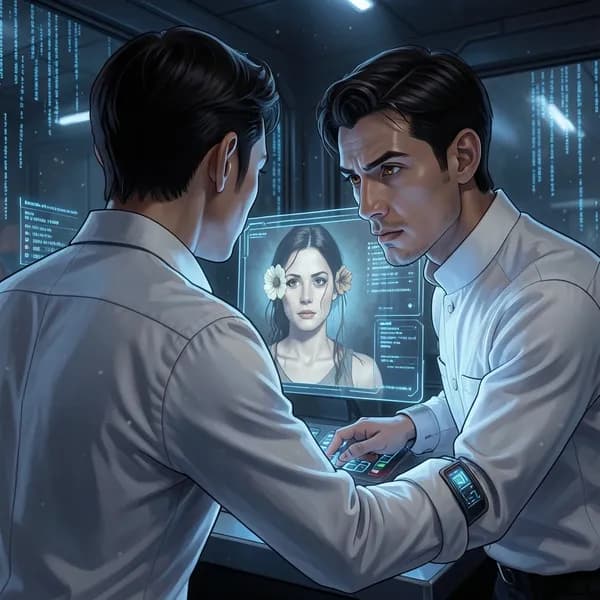
You look at the monitor. A woman is clutching a wilted flower, her pulse erratic, tears tracking through her regulation makeup. To dispatch the drone is to erase her memory of whatever sorrow she feels. To ignore it is to mark yourself as a malfunctioning unit.
“I am recalibrating the sensors, Vane. The signal might be a glitch in the transmitter.”
Vane leans closer, the scent of antiseptic clinging to his uniform. He stares at the screen, his hand resting on the console right beside yours. You have three seconds to decide whether to trigger the drone or buy this stranger a moment of genuine grief.
Vane’s eyes narrow as he watches the monitor. How do you handle the discrepancy in the blue sector?
Your character. Your next move.
The cracks are showing. Will you be the one to break the glass?
The sensors are tracking your heartbeat, and your wellness score is dipping. You have one chance to bypass the security grid and meet your contact in the lower sectors. Every second you hesitate, the system gets closer to identifying you as a threat. Make your choice now—before the city decides for you.
Begin your rebellionYour Story, Your Way
Everything is customizable. Pick any genre, setting, or character — the AI builds a world around exactly what you want.
Any Character
Design your appearance, personality, backstory — every detail
Any World
Fantasy kingdoms, sci-fi stations, modern cities — you choose
Branching Paths
No two playthroughs are the same. Your choices reshape everything
Full Immersion
AI images, voice acting, sound effects — a living story
Hack the city's biometric scanners to move undetected through restricted, high-security residential zones.
Choose whether to report a friend for suspicious behavior or risk your own standing.
Manage your digital 'social credit' score to gain access to forbidden, undocumented archives.
Decide if you will lead a quiet life or spark a revolution in the shadows.
Hitoshi wipes the condensation from his smart-glass window, staring at the manicured lawns of Sector 4. The air is filtered to a precise, refreshing scent of ozone and jasmine. Everyone here is healthy, employed, and perpetually content, thanks to the mandatory neuro-regulators pulsing at their wrists. Yet, Hitoshi feels the phantom itch of a memory that shouldn't exist: a gray sky and the smell of real rain. When a notification pings on his retinal display—'Your wellness score has dropped 0.4%, please report to the Harmony Center'—he knows his time as a compliant citizen is ending. Every choice you make from this moment forward determines whether you vanish into the city’s incinerators or find the cracks in the foundation of this gilded cage. Will you play the role of the model citizen to survive another day, or will you risk everything to expose the rot hiding beneath the pristine veneer?
What is Utopia Gone Wrong in Dystopian?
The Utopia Gone Wrong trope focuses on societies that claim to have achieved perfection through the elimination of conflict, poverty, or emotional pain. In these settings, the cost of this stability is always the suppression of individuality and the total loss of agency. The horror arises not from chaos, but from the terrifying order of a system that views human complexity as a design flaw. Whether it is the chemically induced bliss of Aldous Huxley’s 'Brave New World' or the controlled neutrality of Lois Lowry’s 'The Giver,' these stories demand that the protagonist confront the reality that their comfort is a lie. When a society mandates happiness, dissatisfaction becomes the ultimate act of treason. These stories are rarely about saving the world; they are about recognizing that the world you inhabit is a prison disguised as a garden. By stripping away the illusion of choice, these narratives force characters to decide if they value the safety of the cage more than the danger of the truth.
Why play Utopia Gone Wrong as an interactive story?
Agency is the most dangerous variable in a world designed for total control. In a standard novel, you watch the protagonist struggle against the system; here, the weight of the surveillance state rests on your decisions. You will constantly weigh the benefit of blending in against the necessity of rebellion. Do you hack the city’s public health database to hide your flagging wellness score, or do you attempt to sabotage the central broadcasting hub that keeps the population sedated? The tension comes from the immediate, tangible consequences of your actions. A single misplaced word during a mandatory social-integration audit could mark you as a dissident, triggering a hunt through the city's labyrinthine, high-tech corridors. You aren't just reading about a character fighting an oppressive regime; you are calculating the risks, managing your resources, and deciding exactly when to stop pretending that everything is fine.
Famous examples of Utopia Gone Wrong in books, film, and games
The trope of the failed utopia persists because it mirrors our own anxieties about technology and governance. In 'Brave New World,' the society is held together by the drug Soma and rigid caste systems. The horror is that the citizens are genuinely happy—they simply lack the capacity to choose anything else. This forces the reader to ask if a life without suffering is worth the loss of humanity. Similarly, the underwater city of Rapture in the video game 'BioShock' presents a utopia built on absolute objectivism and scientific freedom. It collapses not because of external invaders, but because the lack of moral constraints leads to inevitable, gruesome decay. In modern film, 'The Giver' demonstrates how the removal of color and pain creates a bland, stagnant existence where people are incapable of love or deep connection. These examples share a common thread: the more a society strives for absolute order, the more catastrophic the eventual breakdown. Whether it is the loss of memory, the loss of emotion, or the loss of ethics, the trope serves as a warning about the fragility of human freedom. The enduring appeal of this narrative style lies in the protagonist's realization that they are the only person who can see the cracks in the glass, turning their existence into a high-stakes struggle for authenticity in a world built on artificial perfection.
FAQ
What makes a Utopia Gone Wrong story different from standard Dystopian fiction?
Standard dystopian stories often start in a broken, post-apocalyptic, or overtly brutal society. A 'Utopia Gone Wrong' story starts with the appearance of perfection, order, and prosperity. The conflict focuses on the discovery that this comfort is manufactured, coercive, or built upon a dark secret.
How do my choices influence the ending of these stories?
Your choices determine your survival and the fate of the society. You can choose to be a sleeper agent, an active saboteur, or a desperate runaway. Each decision affects your social credit, the vigilance of the authorities, and which allies you encounter in the underground.
Is this genre right for me if I enjoy mystery games?
Yes. Much of the gameplay involves uncovering the hidden history of the city. You will gather clues, decipher encrypted data, and piece together why the world changed, making it a perfect fit for players who enjoy investigative narratives.
Can I play as a villain in these stories?
You can choose to prioritize your own survival at the expense of others, report dissidents to increase your own wellness score, or even climb the ranks of the oppressive regime. The system allows for morally ambiguous paths.
Explore more Dystopian stories like Totalitarian Regime, Resistance Movement, Thought Police.
More Dystopian Stories
Totalitarian Regime
The state controls everything — your words, your thoughts, your future. Navigate a suffocating regime where obedience means survival and rebellion means death in this dystopian interactive story.
TropeResistance Movement
The underground is growing, and they want you. Join a secret resistance fighting to overthrow an oppressive system, knowing that every meeting could be your last.
TropeThought Police
Your thoughts are not your own — or at least they shouldn't be. Evade the agents who monitor minds and punish dissent in a world where thinking the wrong thing is a death sentence.
TropePropaganda Machine
The truth is whatever the state says it is. Work inside or against a propaganda machine that rewrites history daily, and decide what reality means when facts are forbidden.
TropeForbidden Love
Love is outlawed, regulated, or assigned by the state. Pursue a forbidden connection that threatens everything you've built in a world designed to crush human attachment.
TropeEscape the City
Beyond the walls lies the unknown, but inside the city lies certain oppression. Plan your escape from a controlled metropolis where every exit is watched and every absence is noticed.