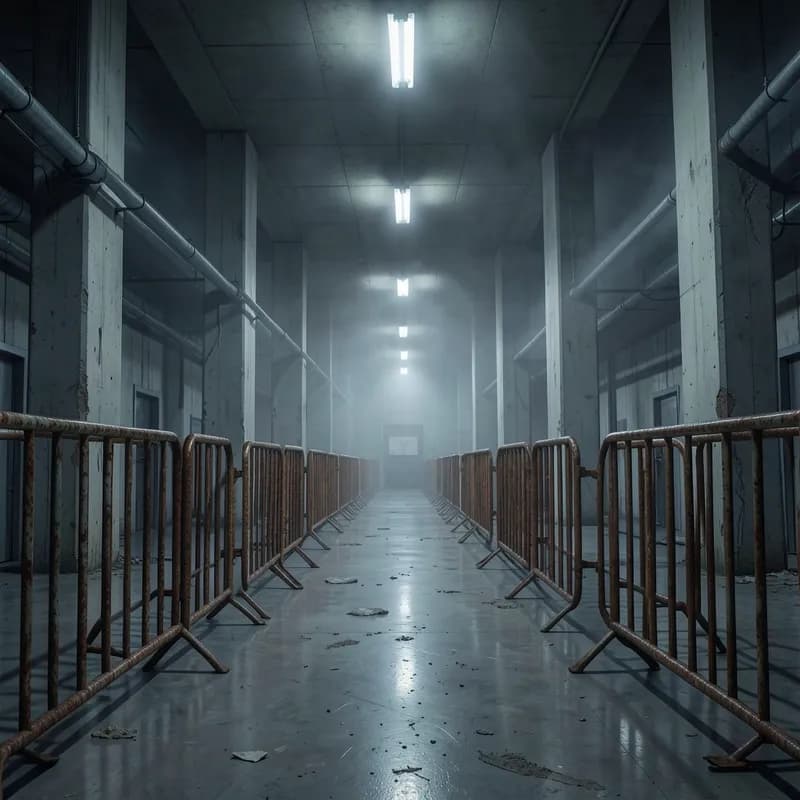
Dystopian · Interactive story
Rationing Center: The Price of Survival
One ticket, one loaf, and a thousand eyes watching your every move.
Start as a guest. Choose your character before the story begins.

Meet the sample character
The price of survival is written in red ink.
Try a scene · No signup
Dust and Calorie Counts
A short sample of this world. Your own version starts with your character.
You press your palms against the freezing metal counter, the stench of unwashed bodies and burnt synthetic paste filling your lungs. The line ahead moves with agonizing slowness, a snake of gray uniforms and hollowed-out eyes. You check your coat pocket, feeling the jagged edge of the forged ration card. If they scan it, you disappear. If they don't, your sister survives another week.
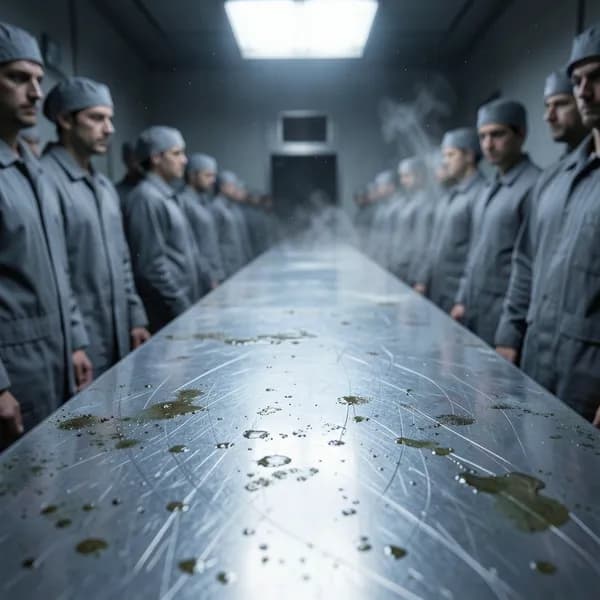
“Stop fiddling with your pockets, Jaren. You think I don't see that twitch in your fingers?”
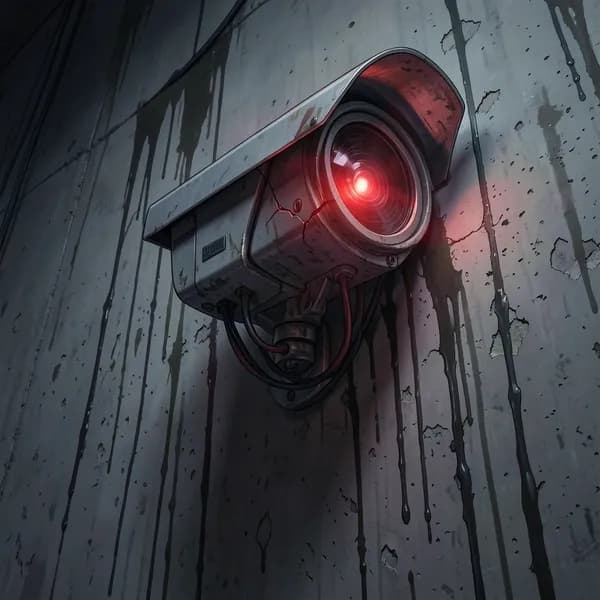
Your heart hammers against your ribs like a trapped bird. Silas isn't just watching; he is waiting for a reason to pull you from the line. The clerk behind the counter glares at his screen, his hand resting near the emergency alarm button. You realize he is holding the daily permit stack, and the top one is marked with a red ink seal—the authorization for double rations.
“I am just cold, Silas. We have been waiting for three hours in the frost.”
The clerk sighs, his finger hovering over the biometric sensor. He looks up, his gaze heavy with indifference. You realize the security camera above is rotating toward your head. You have seconds to act before your card is processed and your forgery is detected, or worse, someone else takes the double ration permit.
The clerk reaches for your card. How do you handle the bottleneck?
Your character. Your next move.
Will you survive the line?
The guard is looking at you. Your ration card is expired. The sirens are beginning to wail in the distance. Do you run, fight, or offer up the only secret you have left? Your choices in this rationing center define your path through the crumbling city.
Join the queueYour Story, Your Way
Everything is customizable. Pick any genre, setting, or character — the AI builds a world around exactly what you want.
Any Character
Design your appearance, personality, backstory — every detail
Any World
Fantasy kingdoms, sci-fi stations, modern cities — you choose
Branching Paths
No two playthroughs are the same. Your choices reshape everything
Full Immersion
AI images, voice acting, sound effects — a living story
Negotiate with corrupt guards to secure extra medical supplies for the sector’s sick.
Decide whether to sabotage the distribution system during a rare power fluctuation.
Trade your daily caloric allowance for a map of the underground tunnels.
Choose to incite a riot when the center runs out of supplies prematurely.
The air inside the concrete bunker tastes like ozone and stale sweat. You tighten your coat, clutching the crumpled paper slip that grants you—if the guards are feeling generous—a week’s worth of gray protein mash. Ahead, the line snakes into the shadows, a silent parade of hollow-eyed citizens. Behind you, a man whispers about a black market trade happening near the ventilation shaft, his voice barely audible over the hum of the surveillance drones circling the ceiling. You reach the counter. The guard stares through you, his hand hovering over a stun baton. Your decision here ripples through the sector, affecting not just your own hunger, but the lives of those waiting in the dark with you. In this interactive story, your choices dictate whether you remain a ghost in the system or the spark that ignites the resistance.
What is Rationing Center in Dystopian?
Rationing centers act as the physical manifestation of a regime's total control over the individual. It is the place where the abstract power of the state becomes tangible—a calorie count, a liter of water, or a medical dose. In George Orwell’s 1984, the struggle for resources reflects the psychological erosion of the populace, while in Alfonso Cuarón’s Children of Men, the scarcity of resources drives the frantic, desperate energy of the entire world. These centers are the choke points of society. They serve as the heartbeat of a dystopian state because they are where citizens are most vulnerable, most predictable, and most easily manipulated. When the government controls the basic necessities, they control the population’s behavior. The rationing center is not just a building; it is a mechanism for keeping the spirit broken and the focus narrowed entirely on survival. Whether it’s the grim, industrial aesthetic of a fallout shelter or the clinical, high-tech distribution nodes of a futuristic autocracy, the rationing center is where the ideology of the oppressor meets the biological reality of the oppressed.
Why play Rationing Center as an interactive story?
In an interactive story set within a rationing center, your agency is the most dangerous tool you possess. You aren't just reading about a character’s struggle; you are deciding whether to comply with the regime’s dehumanizing protocols or risk everything for a scrap of information. Do you bribe the guard with your last credit? Do you share your meager rations with the child crying in the corner, knowing it leaves you weaker for the shift in the mines? The tension comes from the constant friction between self-preservation and moral integrity. You might find yourself trading favors for prohibited tech, dodging cameras, or deciding which neighbor to report to avoid being targeted yourself. Every interaction is a gamble, and the consequences of your choices manifest in real-time, shifting the world around you.
What makes Rationing Center work: the worldbuilding
The rationing center serves as a crucible for character development. It is a setting that forces the protagonist to show their true colors under extreme pressure. In works like Fallout, the scarcity of clean water and resources turns every trade into a life-or-death negotiation. The most effective stories in this setting prioritize sensory detail: the smell of industrial cleaner masking decay, the rhythmic thud of boots on concrete, and the oppressive silence of a crowd that knows speaking out means execution. A successful narrative here focuses on the micro-dystopia—the way a government’s overarching cruelty manifests in a single, small-scale interaction. Characters who thrive in this environment are often forced to be pragmatic, cold, and observant. They don't have the luxury of idealism. The environment should feel claustrophobic, highlighting the power imbalance between the state and the individual. By focusing on the mundane horrors of survival, you create a stakes-heavy environment where a missing ration card can feel as significant as a battlefield loss. Whether your character is a veteran of the regime’s wars or a civilian trying to keep their family fed, the rationing center provides a perfect backdrop for stories about the limits of human endurance.
FAQ
What makes a rationing center setting effective?
It distills the overwhelming power of a government into one tangible, high-stakes location, making the threat feel personal rather than abstract.
How does choice impact survival in this setting?
Every decision forces a trade-off between health, reputation, and freedom from regime surveillance. One wrong move can lose you your rations or your life.
Can I play as a rebel in this setting?
Yes. You can choose to work from within the system to undermine it, act as a smuggler, or openly defy the guards at the risk of your own safety.
What are the main risks at a rationing center?
The primary risks include detection by surveillance drones, betrayal by fellow citizens, and the physical decline caused by starvation.
Explore more Dystopian stories like Totalitarian Regime, Resistance Movement, Thought Police.
More Dystopian Stories
Totalitarian Regime
The state controls everything — your words, your thoughts, your future. Navigate a suffocating regime where obedience means survival and rebellion means death in this dystopian interactive story.
TropeResistance Movement
The underground is growing, and they want you. Join a secret resistance fighting to overthrow an oppressive system, knowing that every meeting could be your last.
TropeThought Police
Your thoughts are not your own — or at least they shouldn't be. Evade the agents who monitor minds and punish dissent in a world where thinking the wrong thing is a death sentence.
TropePropaganda Machine
The truth is whatever the state says it is. Work inside or against a propaganda machine that rewrites history daily, and decide what reality means when facts are forbidden.
TropeForbidden Love
Love is outlawed, regulated, or assigned by the state. Pursue a forbidden connection that threatens everything you've built in a world designed to crush human attachment.
TropeEscape the City
Beyond the walls lies the unknown, but inside the city lies certain oppression. Plan your escape from a controlled metropolis where every exit is watched and every absence is noticed.