
Dystopian · Interactive story
Beyond the Perimeter: The Forbidden Zone
The wall isn't there to keep you in; it's there to keep the truth out.
Start as a guest. Choose your character before the story begins.
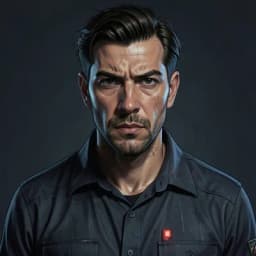
Meet the sample character
The fence doesn't keep the monsters out; it keeps the truth in.
Try a scene · No signup
Static on the Perimeter
A short sample of this world. Your own version starts with your character.
Your fingers ache from gripping the cold steel wire. Ahead, the Forbidden Zone is a wall of shadows and static, broken only by the rhythmic flash of the security beacons. You have the pulse-emitter key tucked against your ribs, its faint blue light flickering as it bleeds energy. If the sensors catch your heat signature, the automated turrets will turn you into scrap metal before you can even scream.
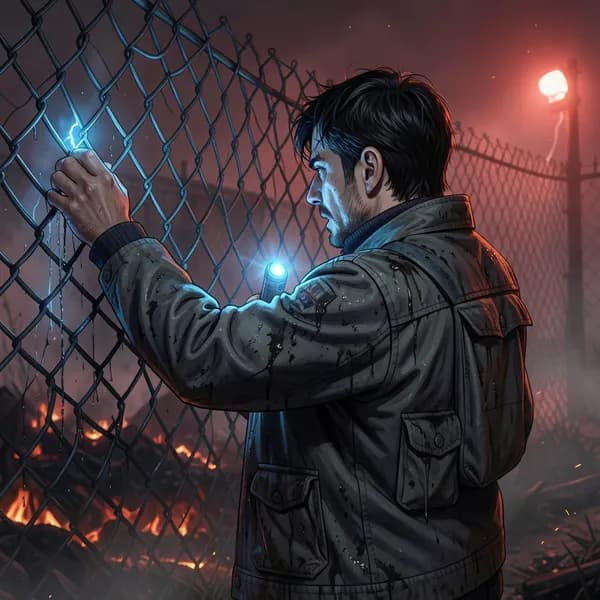
“Stop right there, technician. I see your shadow leaning against the mesh. Move away, or I authorize the perimeter purge.”
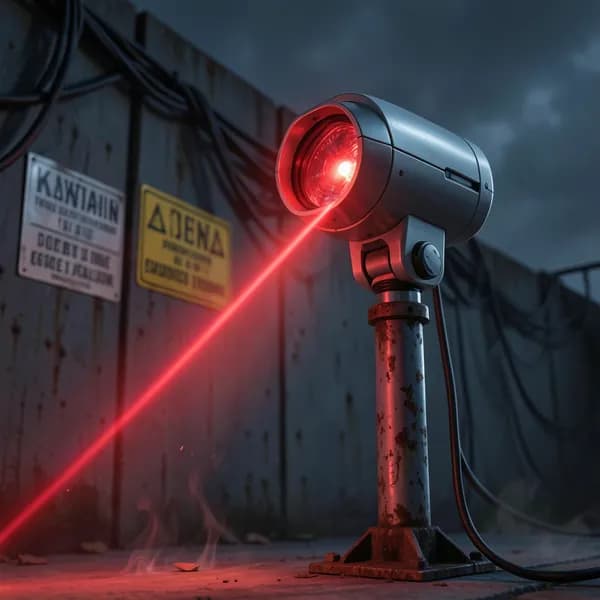
Krell’s voice crackles over the loudspeaker, flat and devoid of humanity. He isn't walking your way yet, but he is watching the thermal feed. Your heart hammers against your chest, a drumbeat of panic you have to swallow down. You have seconds before the sweep hits your position. You can cut the power, run for the dark, or surrender and hope your maintenance clearance buys you a reprieve.
“I’m not a target, Krell. I’m the only one who knows why the power grid under the Zone is failing, and if you kill me, the whole sector goes dark tonight.”
The hum of the fence surges, the voltage climbing to a lethal hum. The red light of the scanner crawls toward your boots, exposing your position. Krell stops his approach, his hand resting on his sidearm, clearly weighing your utility against his orders. The turret above tracks your movement with a mechanical whine. One twitch, one wrong word, and the story ends here in the dirt.
Krell is hesitating, but the sensor sweep is moments away. How will you force the situation?
Your character. Your next move.
Will you cross the perimeter?
The fence is buzzing, and the patrol drones are circling back toward your position. You have one chance to slip into the ruins and find the truth the regime is hiding. If you hesitate, you remain a prisoner. If you move, the game begins. Choose your path now.
Breach the PerimeterYour Story, Your Way
Everything is customizable. Pick any genre, setting, or character — the AI builds a world around exactly what you want.
Any Character
Design your appearance, personality, backstory — every detail
Any World
Fantasy kingdoms, sci-fi stations, modern cities — you choose
Branching Paths
No two playthroughs are the same. Your choices reshape everything
Full Immersion
AI images, voice acting, sound effects — a living story
Decide whether to bypass security sensors or disable them, risking an immediate alarm.
Scavenge for limited medical supplies while balancing your exposure to radioactive hotspots.
Choose to align with underground rebel remnants or maintain your independence at all costs.
Solve environmental puzzles using salvaged tech to unlock restricted, hidden research sectors.
Jae-won stares at the electrified fence, the hum of the surveillance drones a constant, buzzing reminder of the penalty for crossing. Most citizens of Sector 7 believe the propaganda: the lands beyond the wall are scorched, radioactive, and devoid of life. But Jae-won has seen the flickering signal transmissions coming from the heart of the ruins. You stand at the boundary, your fingers trembling as you disable the motion sensors. A single misstep triggers a lethal response from the Sentinels patrolling the perimeter. Your decisions dictate whether you uncover the regime’s hidden facility or become another forgotten statistic in the dirt. This interactive story requires you to manage your resources, maintain your stealth, and decide who to trust when the shadows themselves seem to be watching.
What is the Forbidden Zone in dystopian fiction?
In dystopian storytelling, the Forbidden Zone is a cordoned-off, high-risk territory that serves as a physical manifestation of a regime's lies. It is the blank space on the map where the state claims nothing remains, yet it is often the repository for the regime's most dangerous secrets—be it abandoned research, historical truth, or the remnants of a resistance that failed decades ago. In films like 'Escape from New York,' the island of Manhattan is a literal prison-zone, while in the 'Metro 2033' series, the surface of the earth is a radioactive wasteland that holds the key to the protagonist's survival. These zones exist to enforce the status quo; they create a binary between the 'civilized' city and the 'dead' wilderness. When a narrative focuses on this setting, the stakes are immediate. The environment itself acts as an antagonist, forcing characters to adapt to harsh, unpredictable conditions while hunted by the very authorities who claim the area is uninhabitable.
Why play the Forbidden Zone as an interactive story?
Agency changes the way you view the Forbidden Zone. Instead of watching a protagonist make foolish decisions, you are the one deciding whether to scavenge for supplies in a crumbling chemical plant or prioritize speed to stay ahead of a patrol unit. The tension comes from the scarcity of information. You might find a encrypted data pad—do you spend precious time trying to decrypt it, knowing the noise will attract nearby drones, or do you leave it behind to ensure your own safety? Every interaction with a scavenger you encounter forces a moral calculation: is this person an ally, or a plant sent by the regime to lure you into a trap? By putting these choices in your hands, the story becomes a high-stakes simulation of survival where the consequences of your failures are permanent and the rewards for your ingenuity are rarely guaranteed.
What makes the Forbidden Zone work: the worldbuilding
Effective Forbidden Zone narratives rely on the contrast between the sterile, controlled environment of the city and the chaotic, decaying reality of the restricted area. The zone must feel like a place that has been erased from history. Sensory details are paramount here: the smell of ozone, the crunch of shattered glass under boots, and the oppressive silence that is periodically broken by the mechanical whine of a patrolling drone. The conflict is generated by the tension between the regime’s narrative and the physical evidence you uncover. In 'The Hunger Games,' District 13 serves as a hidden, forbidden sector that forces the characters to reconcile their past with their present. Similarly, 'Stalker' portrays the Zone as a sentient, shifting entity that tests the moral character of those who enter. To make this setting work, the world must feel physically dangerous, but it must also feel psychologically heavy. The ruins should tell a story of what was lost, and your character’s reaction to these ghosts defines the trajectory of the plot. What was this place before the regime sealed it off? Why is it still being guarded so heavily if there is nothing left? By answering these questions through exploration rather than exposition, the story keeps the reader engaged in the mystery of the wasteland.
FAQ
How does the Forbidden Zone differ from a standard wasteland setting?
A standard wasteland is typically a post-apocalyptic setting where society has collapsed entirely. A Forbidden Zone is specifically dystopian; it is a restricted area within an otherwise functioning, oppressive state. The threat comes not just from the environment, but from the active efforts of the regime to keep people out.
Can I choose to play as a defector from the regime?
Yes. Your background is part of the narrative setup. You can choose to be a former surveillance officer who knows the patrol patterns of the Forbidden Zone, or a street-level scavenger who has spent years dreaming of what lies beyond the wall.
How do choices impact my survival in the Forbidden Zone?
Every choice affects your health, stealth rating, and resource levels. If you are too loud or take too many risks, you will be tracked by the regime's forces, which leads to different branches of the story—including capture or death.
Is this story setting suitable for long-form narratives?
Absolutely. The Forbidden Zone is designed to be a multi-layered setting. You can spend your time focusing on small-scale survival or shift the story toward uncovering a massive conspiracy that could topple the government.
Explore more Dystopian stories like Totalitarian Regime, Resistance Movement, Thought Police.
More Dystopian Stories
Totalitarian Regime
The state controls everything — your words, your thoughts, your future. Navigate a suffocating regime where obedience means survival and rebellion means death in this dystopian interactive story.
TropeResistance Movement
The underground is growing, and they want you. Join a secret resistance fighting to overthrow an oppressive system, knowing that every meeting could be your last.
TropeThought Police
Your thoughts are not your own — or at least they shouldn't be. Evade the agents who monitor minds and punish dissent in a world where thinking the wrong thing is a death sentence.
TropePropaganda Machine
The truth is whatever the state says it is. Work inside or against a propaganda machine that rewrites history daily, and decide what reality means when facts are forbidden.
TropeForbidden Love
Love is outlawed, regulated, or assigned by the state. Pursue a forbidden connection that threatens everything you've built in a world designed to crush human attachment.
TropeEscape the City
Beyond the walls lies the unknown, but inside the city lies certain oppression. Plan your escape from a controlled metropolis where every exit is watched and every absence is noticed.