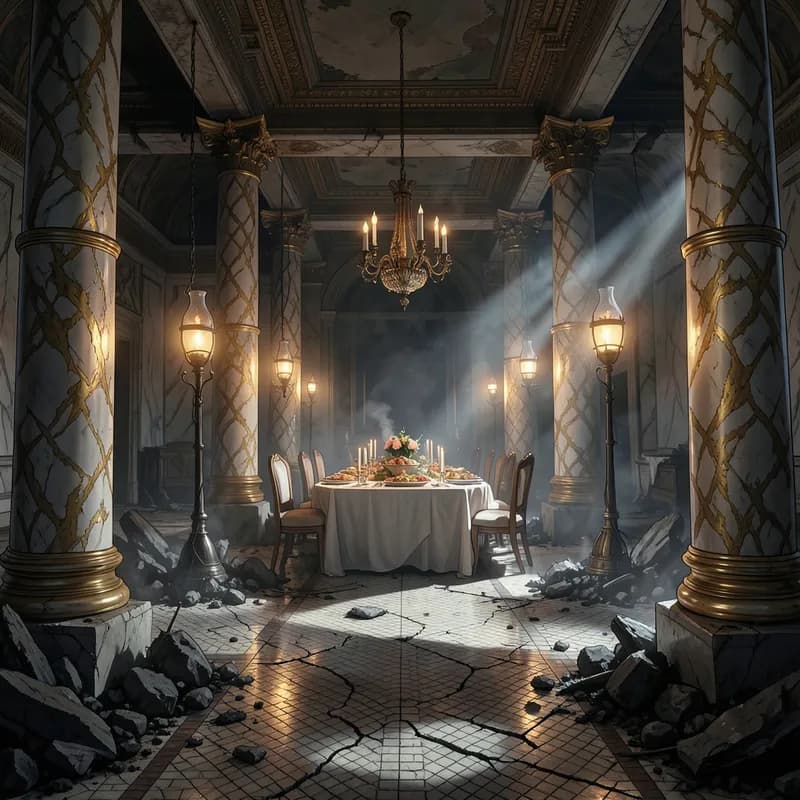
Dystopian · Interactive story
The Shadow of Rome: Surviving Nero’s Court
Gold glitters, but the streets smell of ash. How long can you survive?
Start as a guest. Choose your character before the story begins.

Meet the sample character
A chronicle of ash and absolute rule
Try a scene · No signup
The Cinders of the Palatine
A short sample of this world. Your own version starts with your character.
You stand in the shadow of a marble pillar, the smell of ozone and expensive wine thick in your nostrils. Nero reclines on his velvet couch, his eyes darting toward the vaulted ceiling as if expecting the roof to collapse. The rhythmic clatter of metal boots echoes against the mosaic floor; the Praetorian guards are watching you. They know you have access to the restricted archives, and they suspect you have seen the truth of the fires.
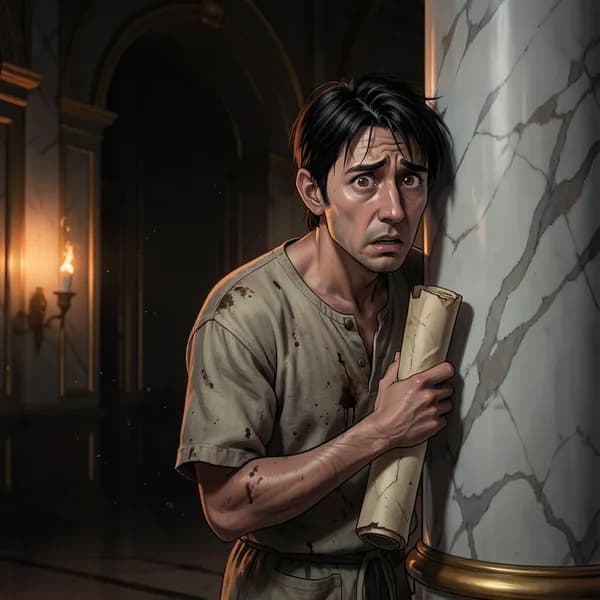
“The scroll, Titus. Read the names of the rats who think they can hide in my shadow.”

You feel the heavy, curled parchment weighing down your tunic, the ink still wet with the Emperor’s paranoia. If you read the names, you condemn innocent men to the arena. If you refuse, the guards will have you dragged to the subterranean pits before the wine is finished. The air in the hall grows thin, and the heat from the nearby braziers feels suffocating.
“My Emperor, the list is... incomplete. Some names are smudged by the grease of the kitchens.”
Nero leans forward, his gaze locking onto yours with a terrifying, glassy intensity. He does not believe you. He slowly reaches for a rusted dagger resting on the table, his fingers tracing the edge of the blade. The entire room goes silent. You have one chance to steer this conversation away from your own neck, or the floor of the Golden House will soon be stained with your blood.
The dagger is moving closer to the scroll. How do you stall the Emperor?
Your character. Your next move.
The flames are rising. Will you survive?
Nero is waiting, and he has a song to finish. Every moment you hesitate is a moment the Praetorian Guard gets closer to your door. Decide your path—serve the empire, protect the innocent, or watch it all burn. The choice is yours.
Play the Nero storyYour Story, Your Way
Everything is customizable. Pick any genre, setting, or character — the AI builds a world around exactly what you want.
Any Character
Design your appearance, personality, backstory — every detail
Any World
Fantasy kingdoms, sci-fi stations, modern cities — you choose
Branching Paths
No two playthroughs are the same. Your choices reshape everything
Full Immersion
AI images, voice acting, sound effects — a living story
Decide whether to report a suspected traitor to the Praetorian Guard for personal gain.
Choose which illicit documents to hide before the imperial inspectors raid your family home.
Navigate the shifting allegiances of the Senate as the emperor’s paranoia reaches its breaking point.
The scent of roasting meat mixes with the acrid sting of smoke. You stand in the shadows of the Palatine Hill, watching the golden flames lick the horizon as the city dies. Beside you, a centurion wipes blood from his blade, his eyes darting toward the imperial balcony where Nero watches the chaos, a lyre held loosely in his manicured hand. Every breath here is a gamble. Your words, your silence, and your allegiances dictate whether you emerge as a favorite of the court or a footnote in the ashes of the Forum. In this story, your choices determine the fate of an empire teetering on the edge of madness.
What is Emperor Nero in Dystopian?
Nero, the final emperor of the Julio-Claudian dynasty, remains the historical archetype of the absolute tyrant. He was not just a ruler; he was a performer who demanded an audience for his poetry while Rome crumbled. In literature and film, he is often depicted as a man unmoored from reality—think of the volatile portrayal in Henryk Sienkiewicz’s Quo Vadis, where his obsession with his own artistic genius leads to mass persecution. He is the ultimate antagonist because he possesses the power to rewrite the rules of morality to suit his whims. Whether it is the manipulative schemer found in Robert Graves’ I, Claudius or the erratic, paranoid figure in modern historical dramas, the character of Nero serves as a mirror to the dangers of unchecked vanity. He represents the pinnacle of a surveillance state, where the emperor’s gaze is everywhere, and his favor is more dangerous than his wrath.
Why play Emperor Nero as an interactive story?
Playing in Nero’s Rome means moving through a web of whispers. You are not a hero with a sword; you are a survivor with a secret. You will face dilemmas that force you to choose between personal survival and the lives of those who look to you for leadership. Do you betray a fellow conspirator to gain a seat at the emperor's table, or do you risk an agonizing execution to smuggle supplies to the underground resistance? The tension comes from the proximity to power. You see the madness up close, feeling the weight of the emperor's gaze during a banquet, knowing that a single wrong word could end in a visit from the Praetorian Guard. You must balance the necessity of blending in with the burning desire to end the tyranny before the entire city is consumed by fire.
The literary legacy of Emperor Nero
Nero’s cultural footprint is vast, stemming from the historical accounts of Tacitus and Suetonius, which painted him as a matricidal monster. These ancient chroniclers established the blueprint for the literary Nero: the artist-tyrant. In the 1896 novel Quo Vadis, Nero became the embodiment of state-sponsored cruelty, a figure whose artistic vanity provided a chilling contrast to the suffering of the early Christians. This juxtaposition—the beautiful music against the screams of the dying—is what makes the character endure. Later adaptations, such as the 1951 film Quo Vadis or the nuanced interpretations in modern historical fiction, continue to explore this tension. Modern writers often focus on the psychological decay of a man trapped by his own absolute power. Nero remains relevant because he forces us to confront the question of what happens when the most powerful person in a society loses their grip on reality. He is the cautionary tale that never grows old, a reminder that tyranny often arrives with a smile and a song.
FAQ
Can I change the outcome of the Great Fire of Rome?
Yes. Your actions throughout the story determine whether you can organize a resistance to mitigate the destruction or if you are forced to flee the city as it burns.
Is this story historically accurate?
It blends historical figures and events with fictional choices, allowing you to influence the trajectory of events while remaining grounded in the atmosphere of ancient Rome.
Do I need to know Roman history to play?
No. The story provides the context necessary to understand the stakes, the players, and the danger of living in Nero’s court.
Can I play as someone other than a member of the court?
You start as a person with proximity to the inner circle, but your choices allow you to align with the resistance, the military, or the imperial household.
Explore more Dystopian stories like Totalitarian Regime, Resistance Movement, Thought Police.
More Dystopian Stories
Totalitarian Regime
The state controls everything — your words, your thoughts, your future. Navigate a suffocating regime where obedience means survival and rebellion means death in this dystopian interactive story.
TropeResistance Movement
The underground is growing, and they want you. Join a secret resistance fighting to overthrow an oppressive system, knowing that every meeting could be your last.
TropeThought Police
Your thoughts are not your own — or at least they shouldn't be. Evade the agents who monitor minds and punish dissent in a world where thinking the wrong thing is a death sentence.
TropePropaganda Machine
The truth is whatever the state says it is. Work inside or against a propaganda machine that rewrites history daily, and decide what reality means when facts are forbidden.
TropeForbidden Love
Love is outlawed, regulated, or assigned by the state. Pursue a forbidden connection that threatens everything you've built in a world designed to crush human attachment.
TropeEscape the City
Beyond the walls lies the unknown, but inside the city lies certain oppression. Plan your escape from a controlled metropolis where every exit is watched and every absence is noticed.