Dystopian · Interactive story
Above the Clouds, Below the Iron
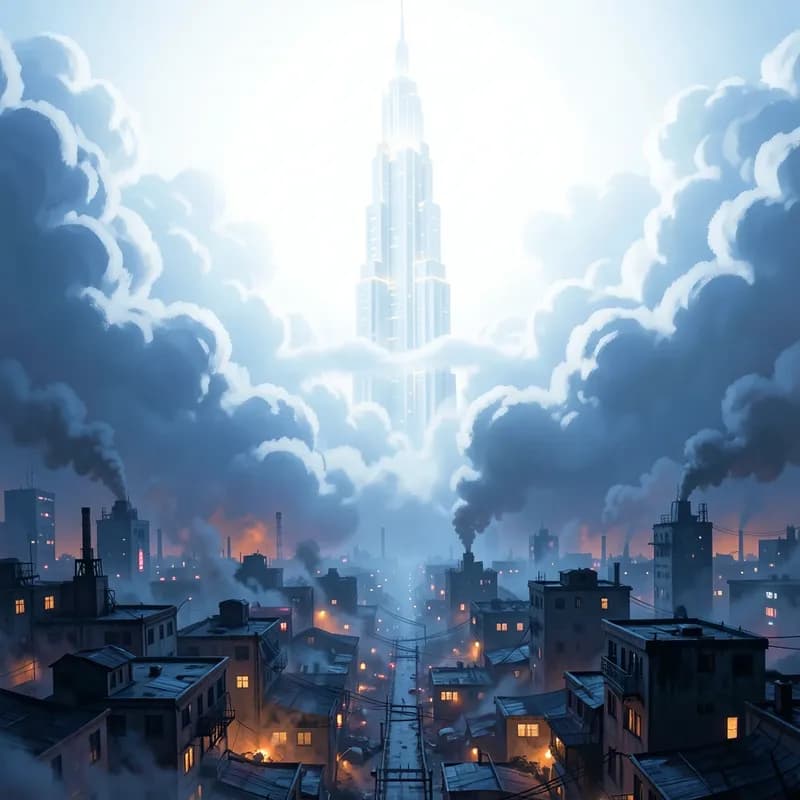
The gold-plated spires look down on the soot-stained streets. Which side do you feed?
Start as a guest. Choose your character before the story begins.

Meet the sample character
The Spire demands payment in blood.
Try a scene · No signup
Neon Scraps, Golden Air
A short sample of this world. Your own version starts with your character.
The floor beneath your boots is polished marble, a sickening contrast to the rusted grates of your home in the Sump. You stand in the transit lobby of Level 90, clutching a thermal-sealed courier bag. Your pulse echoes in your ears like a war drum. A sanitation drone hums overhead, its red optic lens tracking your every breath. You shouldn't be here, but the credits promised for this delivery are enough to feed your family for a year.

“You’re five minutes late and three levels above your clearance, scavenger. Hand it over, or I’ll let the air scrubbers vent you out.”

The guard’s hand rests on the grip of his stun-baton, the blue casing crackling with restrained energy. He doesn't know what is inside the bag—only that it’s forbidden. The security gate behind him is locked, trapping you in this pristine white hallway. Sweat beads on your forehead, blurring your vision. You have seconds before his patience evaporates into violence, and your hand is already ghosting over the release mechanism of the bag.
“It’s a fragile delivery for the board of directors. If you break it, you’re the one answering to them when the power fails.”
The guard pauses, his eyes narrowing as he weighs the threat against his own fear of the board. The silence in the hallway is absolute, save for the mechanical whine of the ventilation shafts. If you push him now, you might force your way through the service hatch, but if you miscalculate, you’ll be discarded in the waste chutes before the next shift starts. The decision is tightening around your throat.
How do you handle the guard before he decides you're a threat?
Your character. Your next move.
The revolution needs a leader.
The elite are watching from their balconies, waiting for you to stumble. Will you force them to look down, or will you vanish into the smog? Take control of the rebellion now.
Start the UprisingYour Story, Your Way
Everything is customizable. Pick any genre, setting, or character — the AI builds a world around exactly what you want.
Any Character
Design your appearance, personality, backstory — every detail
Any World
Fantasy kingdoms, sci-fi stations, modern cities — you choose
Branching Paths
No two playthroughs are the same. Your choices reshape everything
Full Immersion
AI images, voice acting, sound effects — a living story
Hack the city’s surveillance network to grant your district temporary access to clean water.
Decide whether to assassinate a high-ranking official or recruit them as a double agent.
Trade your limited rations to bribe a guard for access to the restricted sector.
Jin-ho wipes the industrial grease from his forehead, looking up at the floating platforms of the Sector 1 elite. Up there, the air is filtered and the water runs clear. Down here, the ventilation fans groan under the weight of a century of grime. You are holding the detonator for an EMP device meant to knock their power grid offline. If you press the trigger, the lights in the spires go out, but the life support for the lower levels might fail in the surge. Every choice you make in this broken society ripples through the divide, forcing you to weigh the cost of a revolution against the lives of your own neighbors. You decide whether to ignite the city or find a way to survive the fallout.
What is Class Warfare in Dystopian?
Class warfare in fiction functions as a pressure cooker. It highlights the friction between those holding all the resources and those clawing for scraps. Think of Bong Joon-ho’s film Snowpiercer; the train is a microcosm of society where the tail section is a literal prison of poverty while the engine room is a paradise of excess. The trope works because it forces characters into impossible corners. It is not about simply hating the wealthy; it is about the systemic machinery that keeps the poor from ever reaching the top. When stories use this setting, they are asking a fundamental question: if the system is rigged, is it better to tear it down or try to climb the ladder? These narratives thrive on the tension of limited resources and the constant threat of those who benefit from the status quo.
Why play Class Warfare as an interactive story?
You are not watching a movie; you are making the calls that define the survival of your kin. The tension comes from the scarcity of resources. When you have to choose between stealing medicine for a sick child or sabotaging a supply line that helps the rebellion, the stakes feel personal. You will encounter characters who have grown comfortable in their luxury and others who have forgotten what sunlight looks like. Your agency changes the outcome—will you be a martyr, a diplomat, or the architect of a new order? Every decision carries weight, and the consequences of your actions will ripple through the city, affecting your standing with both the resistance and the ruling class.
Famous examples of Class Warfare in books, film, and games
In the film Elysium, the divide is physical—the wealthy live on a space station while the Earth is a scorched wasteland. The film uses this to show the absolute indifference of the powerful toward the sick and the starving. Contrast this with The Hunger Games, where class is weaponized as a form of entertainment and control. The Capitol uses the suffering of the districts as a reminder of who holds the whip, turning survival into a televised spectacle. Then look at the game Final Fantasy VII, where Midgar’s plate separates the wealthy from the slums below, and the environmental destruction caused by the elite directly kills the people underneath. These stories endure because they mirror the real-world anxiety of inequality. They ask us what we would do if the gap between the haves and have-nots became an uncrossable chasm, forcing characters to choose between their own safety and the collective good.
FAQ
What is a class warfare story?
A class warfare story focuses on the conflict between distinct social tiers, typically involving a group of disenfranchised people fighting against an oppressive elite. The conflict usually centers on resource control, civil rights, or survival.
Why are these settings so popular in fiction?
These settings allow authors and players to explore social dynamics and moral dilemmas. They provide a high-stakes environment where every choice feels significant because the characters often have very little to lose.
Can I play as a villain in these stories?
Yes. You have the freedom to decide your moral compass. You can act as a ruthless revolutionary, a selfish opportunist, or even a sympathetic figure within the ruling class trying to change things from the inside.
Are these stories realistic?
While the technology or settings may be futuristic, the social dynamics are often based on historical and current real-world power imbalances, making them feel grounded and urgent.
Explore more Dystopian stories like Totalitarian Regime, Resistance Movement, Thought Police.
More Dystopian Stories
Totalitarian Regime
The state controls everything — your words, your thoughts, your future. Navigate a suffocating regime where obedience means survival and rebellion means death in this dystopian interactive story.
TropeResistance Movement
The underground is growing, and they want you. Join a secret resistance fighting to overthrow an oppressive system, knowing that every meeting could be your last.
TropeThought Police
Your thoughts are not your own — or at least they shouldn't be. Evade the agents who monitor minds and punish dissent in a world where thinking the wrong thing is a death sentence.
TropePropaganda Machine
The truth is whatever the state says it is. Work inside or against a propaganda machine that rewrites history daily, and decide what reality means when facts are forbidden.
TropeForbidden Love
Love is outlawed, regulated, or assigned by the state. Pursue a forbidden connection that threatens everything you've built in a world designed to crush human attachment.
TropeEscape the City
Beyond the walls lies the unknown, but inside the city lies certain oppression. Plan your escape from a controlled metropolis where every exit is watched and every absence is noticed.