
Dystopian · Interactive story
Words Are Contraband. Start the Uprising.
The regime burns the history books. You hold the last copy. What happens next?
Start as a guest. Choose your character before the story begins.
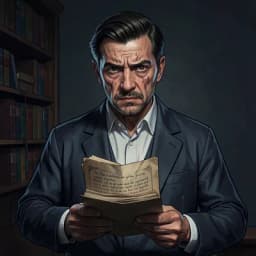
Meet the sample character
Truth is a dangerous commodity in the Ministry of Record.
Try a scene · No signup
The Margin of Error
A short sample of this world. Your own version starts with your character.
The sterile fluorescent lights hum above your desk, flickering in a rhythmic, nerve-wracking pattern. You press your thigh against the desk edge, feeling the sharp, folded edge of the forbidden poem hidden in your inner pocket. Around you, the clerks of the Ministry of Record shuffle through files, their eyes never rising above the gray linoleum. Silence is the only allowed language here.

“Sato. The incident report from District 9 is missing two paragraphs. Explain.”

You feel the paper pressing into your skin. If he searches you, the handwritten words will be his proof that you are more than a cog in the state machine. The air in the room feels thin, sucked away by the ventilation shafts that run like hungry veins through the ceiling. Your pulse is a frantic drum in your ears.
“The files were corrupted by the humidity in the archive vaults, Inspector. I am reconstructing them now.”
Vane steps closer, his boots clicking with rhythmic finality on the floor. He looms over your workstation, his gaze drifting from your face to the slight, unnatural bulge in your pocket. He reaches out a gloved hand toward your desk, his fingers hovering over the very file where you have hidden the illicit verse. He knows. Or he is about to.
Vane is inches away. How do you protect the secret hidden in your pocket?
Your character. Your next move.
The regime is watching. Will you take the risk?
A package of forbidden texts has just arrived on your doorstep. The drones are circling overhead, and your neighbor is staring a little too hard at your front door. Do you hide the evidence, or do you start the fire that burns the whole system down? The choice is yours to make.
Start Your Rebellion NowYour Story, Your Way
Everything is customizable. Pick any genre, setting, or character — the AI builds a world around exactly what you want.
Any Character
Design your appearance, personality, backstory — every detail
Any World
Fantasy kingdoms, sci-fi stations, modern cities — you choose
Branching Paths
No two playthroughs are the same. Your choices reshape everything
Full Immersion
AI images, voice acting, sound effects — a living story
Choose whether to smuggle banned manuscripts past thermal scanners or destroy them to avoid arrest.
Decide which resistance members to trust when state informants are embedded in your social circle.
Select your method of distribution, from underground radio broadcasts to physical pamphlets dropped in public.
Face the consequences of your moral compromises as the regime’s surveillance tightens around you.
The smell of ozone and singed parchment hangs heavy in the basement. Outside, the patrol drones hum, their sensors scanning for the heat signatures of unauthorized gatherings. You clutch a leather-bound volume—a relic of a time when ideas were shared openly, not locked away in state-sanctioned vaults. The government calls it sedition; you call it memory. Every choice you make here dictates whether these pages reach the hands of the resistance or fuel the incinerator. In this environment, silence is a death sentence, but speaking out carries a heavy price. You decide which risks are worth taking. Will you smuggle the text through the border checkpoints, or will you use it to spark a riot in the central plaza? Your decisions ripple outward, shifting the balance of power between the enforcers and those fighting to preserve the truth.
What is Censorship Rebellion in Dystopian?
Censorship Rebellion is a narrative trope centered on the struggle for intellectual freedom against a regime that mandates ignorance. In these stories, the state maintains control by controlling the flow of information, treating literature, art, and history as dangerous contagions. The protagonist is rarely a soldier; often, they are a librarian, a printer, or simply a citizen who accidentally discovers a piece of the past that contradicts the state’s narrative. The conflict arises not just from the physical threat of the regime, but from the psychological weight of knowing truths that no one else is allowed to acknowledge. A quintessential example is Ray Bradbury’s 'Fahrenheit 451,' where firemen exist to burn books rather than extinguish flames. The tension in this trope comes from the contrast between the sterile, controlled reality of the dystopia and the messy, dangerous, and vital potential of forbidden knowledge. It is a battle for the human mind, played out in shadow-filled alleys and secret underground networks.
Why play Censorship Rebellion as an interactive story?
Agency transforms the experience of reading a dystopian novel into a calculation of survival. When you are the one holding the forbidden document, the fear of being caught becomes personal. You are not just observing a character’s struggle; you are weighing the cost of your own survival against the necessity of spreading dangerous ideas. You might face a choice to betray a contact to save yourself, or to bury the evidence and live another day in quiet desperation. These moments force you to confront your own values: how much are you willing to lose to ensure that history is not forgotten? The machine tracks your moral alignment, rewarding or punishing your caution. Every interaction with a state official is a high-stakes negotiation where one wrong word leads to exile or worse. You will decide if the rebellion is worth the blood spilled to protect a few pages of ink.
Famous examples of Censorship Rebellion in books, film, and games
The fear of the written word is a recurring theme in fiction because it mirrors historical anxieties about authoritarianism. In George Orwell’s '1984,' the Party practices a sophisticated form of censorship by rewriting history and restricting language itself through Newspeak. The rebellion here is deeply internal, focused on the effort to maintain a coherent sense of self when the state controls the very tools of thought. Conversely, the video game 'Papers, Please' uses a different, more bureaucratic lens. While not explicitly about books, the game forces the player to manage the flow of people and information at a border crossing, highlighting how censorship and gatekeeping turn neighbors into enemies. In the film 'V for Vendetta,' the rebellion is overt and theatrical, using symbols and art to dismantle the regime’s propaganda. These examples show that the trope is versatile, shifting between quiet, personal defiance and explosive, public insurrection. Whether the focus is on a single book or the entire history of a nation, the core of the conflict remains the same: the state wants you to forget, and the protagonist refuses to let go of the truth. This trope endures because it challenges us to consider what we would fight for if the world tried to erase our past.
FAQ
How do my choices change the ending of the story?
Your choices determine the survival of your resistance cell and the reach of the information you spread. A cautious approach might keep you safe but allow the state to tighten its grip, while reckless rebellion could ignite a revolution—or lead to your total erasure.
Can I play as a villain who supports the censorship regime?
You can certainly choose to prioritize your own safety or align with the regime's interests. The narrative reflects your decisions, allowing you to act as an enforcer or a double agent if you choose to pursue that path.
Is this story game suitable for those who prefer political thrillers?
Yes. The experience focuses heavily on the mechanics of surveillance, information warfare, and ideological conflict, making it a natural fit for players who enjoy high-stakes political intrigue and moral dilemmas.
Does the game require prior knowledge of dystopian literature?
No. While the themes draw from classic dystopian fiction, the narrative provides all the context you need to understand the stakes of your environment and the power of the regime you are opposing.
Explore more Dystopian stories like Totalitarian Regime, Resistance Movement, Thought Police.
More Dystopian Stories
Totalitarian Regime
The state controls everything — your words, your thoughts, your future. Navigate a suffocating regime where obedience means survival and rebellion means death in this dystopian interactive story.
TropeResistance Movement
The underground is growing, and they want you. Join a secret resistance fighting to overthrow an oppressive system, knowing that every meeting could be your last.
TropeThought Police
Your thoughts are not your own — or at least they shouldn't be. Evade the agents who monitor minds and punish dissent in a world where thinking the wrong thing is a death sentence.
TropePropaganda Machine
The truth is whatever the state says it is. Work inside or against a propaganda machine that rewrites history daily, and decide what reality means when facts are forbidden.
TropeForbidden Love
Love is outlawed, regulated, or assigned by the state. Pursue a forbidden connection that threatens everything you've built in a world designed to crush human attachment.
TropeEscape the City
Beyond the walls lies the unknown, but inside the city lies certain oppression. Plan your escape from a controlled metropolis where every exit is watched and every absence is noticed.