
Dark Fantasy · Interactive story
The Morrigan: Blood, Fate, and the Cost of Victory
The battlefield is silent, but the crow is watching. What will you trade for power?
Start as a guest. Choose your character before the story begins.
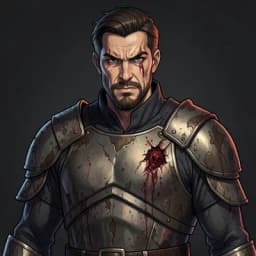
Meet the sample character
The goddess of slaughter demands a tribute measured in heartbeats.
Try a scene · No signup
Crows Upon the Cairn
A short sample of this world. Your own version starts with your character.
The slaughter ended hours ago, but the crows haven't finished. You pick your way through the viscera, searching for anything worth looting. A heavy flap of wings draws your eyes upward. Perched upon a shattered standard, a woman stands—or perhaps she is a collection of shadows held together by malice. Her eyes are voids, reflecting the gray, weeping sky.

“Your blade is notched, your men are carrion, yet you still hunt for scraps of gold in the mud.”

A chill that has nothing to do with the freezing rain crawls up your spine. You recognize the sigils woven into her blood-stained mantle. This is the goddess who decides which warriors see the sunrise and which feed the worms. Your hand drifts to your hilt, but your fingers tremble, heavy with the sudden, crushing weight of your own failures.
“I don't need omens. I need the strength to finish what I started. Name your price.”
She tilts her head, and the crows around her let out a chorus of jagged screams. She steps toward you, the mud beneath her feet not splashing but turning to black, swirling smoke. She reaches out, her skin pale as a winter moon. She promises you the throne of your ancestors, but the price is etched in the cold silence that follows: your brother’s soul, already claimed by the void.
The goddess waits, her hand extended. Will you accept the bargain, or turn your back on the crown?
Your character. Your next move.
Will you accept her bargain?
The stream is red with the blood of those who thought they could ignore the goddess of war. The Morrigan is waiting at the ford, and she has already seen your end. Will you offer her your soul for a chance at glory, or will you face her wrath with nothing but your own steel? Your choices will decide the final tally of the dead.
Face The Morrigan NowYour Story, Your Way
Everything is customizable. Pick any genre, setting, or character — the AI builds a world around exactly what you want.
Any Character
Design your appearance, personality, backstory — every detail
Any World
Fantasy kingdoms, sci-fi stations, modern cities — you choose
Branching Paths
No two playthroughs are the same. Your choices reshape everything
Full Immersion
AI images, voice acting, sound effects — a living story
Reject or accept the goddess’s pact and live with the immediate, bloody consequences.
Sacrifice precious memories or allies to gain forbidden knowledge on the battlefield.
Navigate complex political betrayals where the Morrigan manipulates your every move.
Determine the fate of entire kingdoms through your allegiance to the war goddess.
The smell of iron and rotting heather hangs heavy over the valley of Magh Tuireadh. You stand alone, your sword notched, your armor shattered. Before you, a woman in a cloak of raven feathers stands by a shallow stream, washing the blood from a pile of tunics that look hauntingly like your own. She is the Phantom Queen, the weaver of doom, and she has been waiting for you. Her eyes, cold as a winter tomb, lock onto yours. She offers you the strength to break your enemies, but the price is not gold or land—it is the memory of the one person you swore to protect. In this interactive story, your choices dictate whether you return home as a conqueror or stay here as another ghost in her collection. Every word you speak to the goddess shifts the outcome of the war, and the Morrigan does not bargain in good faith. You have only moments to decide what you are willing to lose.
What is The Morrigan in Dark Fantasy?
The Morrigan is not a benevolent deity; she is the Irish goddess of war, fate, and the inevitable end. Often depicted as a trio of sisters or a solitary figure manifesting as a crow, she represents the brutal reality of conflict. In early texts like the 'Táin Bó Cúailnge,' she is a terrifying force of nature, inciting rage in heroes and terror in armies. She does not pick sides based on morality; she picks sides based on the outcome of the slaughter. In modern dark fantasy, she serves as an archetype of the 'cruel mentor' or the 'inevitable reaper.' Unlike sanitized versions of mythology found in some contemporary fantasy media, the Morrigan remains a chaotic, blood-drenched figure. She appears in various forms, from the cryptic fates in 'The Witcher' series—which echo her tripartite nature—to the terrifying, manipulative entities in Neil Gaiman’s 'American Gods.' When she appears in a story, the narrative is no longer about winning; it is about surviving the exchange of your own soul for a temporary tactical advantage. She is the personification of the idea that in war, everyone loses something, and she is the one who collects the debt.
Why play The Morrigan as an interactive story?
Playing through a narrative where the Morrigan is a central figure forces you to confront the weight of your own morality. In traditional gaming, you usually aim for the 'best' ending. Here, the best ending is often the one where you lose the least. You will face moments where you must choose between saving a village and ensuring your own survival, or between killing an innocent to gain the favor of the goddess. The tension arises from her presence; she is constantly watching, judging, and whispering in your ear. You aren't just reading about a choice—you are feeling the cold blade of it against your throat. You might decide to defy her, rejecting her offer of power, only to realize that the path of the righteous is far more dangerous than the path of the damned. Each decision ripples through the world, affecting the political landscape of the fallen kingdoms you traverse. You are not a hero in the traditional sense; you are a pawn who is trying to become a player before the final act of the war begins.
The literary legacy of The Morrigan
The Morrigan’s roots run deep into the 'Lebor Gabála Érenn' (The Book of Invasions), where she is described as a goddess of sovereignty and destruction. Her character has evolved from a tribal deity of the Tuatha Dé Danann into a literary icon of dread. Historically, she was feared as the 'Washer at the Ford,' a harbinger who appeared to those about to die. If you saw her washing your clothes, your fate was sealed. This imagery persists because it is inherently unsettling—it turns the mundane act of cleaning into a premonition of death. In modern adaptations, she has been reinterpreted across various media. In the game 'Smite,' she is a tactical mage, while in more literary dark fantasy, she is often used to explore the psychological toll of war. Authors and game designers use her to represent the 'cost of victory' trope. She works today because she represents the one thing no one can escape: their own end. Modern audiences gravitate toward her because she is honest. She doesn't promise a happy ending or a glorious reward. She promises only that the war will end, and that she will be there to see it. Her presence demands that the protagonist grows, or at the very least, understands the magnitude of their own mortality. By placing her in an interactive setting, you are forced to engage with a figure that does not care about your 'main character energy.' She cares about the outcome of the battle, and she is the ultimate judge of whether you were worth the blood spilled in your name.
FAQ
What makes the Morrigan different from other mythological gods?
Most gods are concerned with worship or order. The Morrigan is concerned with the mechanics of death. She is a goddess of the battlefield, not the temple. She doesn't want your prayers; she wants the outcome of your struggle.
Can I outsmart the Morrigan in this story?
Outsmarting a deity of fate is the ultimate challenge. You might find ways to twist her deals to your advantage, but be warned: the Morrigan rarely enters a bargain where she doesn't hold the winning hand.
Is this story suitable for fans of dark, gritty fantasy?
If you enjoy stories where choices have permanent, often brutal consequences, this is for you. This is not a high-fantasy quest for glory; it is a grim exploration of what you are willing to sacrifice for power.
How does my choice affect the ending?
Your interactions change the world state. Your alliance with the Morrigan—or your defiance—will dictate which kingdoms fall and who survives the final conflict. Every choice is a thread in a web of consequences.
Explore more Dark Fantasy stories like Grimdark Quest, Morally Gray Hero, Blood Magic.
More Dark Fantasy Stories
Grimdark Quest
There are no shining heroes here — only survivors. You embark on a brutal quest where every victory costs something precious and the line between savior and monster blurs with each bloody mile.
TropeMorally Gray Hero
You do terrible things for complicated reasons, and the world refuses to sort neatly into good and evil. Every choice stains your hands a little darker, but someone has to make the hard calls.
TropeBlood Magic
Power flows through veins, and the strongest spells demand the highest price. You wield a forbidden art that grows more potent with every sacrifice — but the magic is hungry, and it's starting to feed on you.
TropeFallen Kingdom
The kingdom that once stood as a beacon of civilization lies in ashes, its people scattered and its throne cursed. You walk its ruins seeking something worth salvaging from the wreckage of an empire.
TropeDark Prophecy
The seers spoke of an age of ruin, and every omen points to you as its catalyst. You can try to defy the prophecy, embrace it, or twist its words — but fate has teeth and it knows your name.
TropeMonster Pact
Desperation drove you to bargain with something ancient and terrible. The power it grants is immense but the terms of the contract grow more horrifying as you read the fine print written in your own blood.