
Dark Fantasy · Interactive story
The Cold Bargain: Confronting Hel in the Norse Underworld
Your skin is frost-bitten, your breath hitches, and the Queen of the Dead is waiting.
Start as a guest. Choose your character before the story begins.
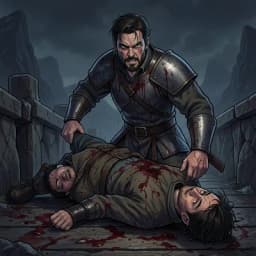
Meet the sample character
No glory awaits the dishonored dead.
Try a scene · No signup
The Frozen Toll
A short sample of this world. Your own version starts with your character.
You drag the corpse of your brother across the threshold of Eljudnir, the soles of your boots slick with the black slush of the underworld. The hall stretches into an infinite, suffocating gloom, illuminated only by the pale, necrotic light bleeding from the goddess herself. Your hands are numb, frost-bitten and trembling, but you refuse to release the heavy, frozen weight of your only kin.

“A shivering whelp brings me a hollow prize. Why drag this rotted shadow into my domain, Hreidar? He died a coward’s death in the dirt. He is mine by right.”

The temperature drops until your breath crystallizes into stinging needles against your face. Hel sits upon her throne, half her body a vibrant, terrifying bloom of life, the other a skeletal ruin of blackened rot. She watches you with eyes that have witnessed the collapse of every mountain and the betrayal of every king. You feel the weight of your own failures pressing down, urging you to kneel or run.
“I offer a trade that bleeds, not gold. Keep his soul, but grant his spirit the strength to fight in your legions, and you will have my service until the end of the world.”
The goddess smiles, and the movement shifts the skin of her face in a sickening, uneven cadence. She leans forward, her dark, decaying hand outstretched to touch the frost on your cheek. She offers you a choice that will either secure your brother’s place among the warriors or bind your own life to this frozen hall forever.
How will you pay the goddess of the dead for your brother's release?
Your character. Your next move.
Will you pay the toll to save them?
The Queen of the Dead is waiting in the frost. Your companion's soul hangs in the balance, and Hel’s eyes are fixed on your heart. One wrong word and you will never see the sun again. Step into the cold and decide what you are willing to lose today.
Bargain with the GoddessYour Story, Your Way
Everything is customizable. Pick any genre, setting, or character — the AI builds a world around exactly what you want.
Any Character
Design your appearance, personality, backstory — every detail
Any World
Fantasy kingdoms, sci-fi stations, modern cities — you choose
Branching Paths
No two playthroughs are the same. Your choices reshape everything
Full Immersion
AI images, voice acting, sound effects — a living story
Trade fragments of your own past to buy back the souls of the fallen.
Navigate complex verbal duels where a single lie triggers your own permanent exile.
Sacrifice physical attributes to appease the Queen of the Dead’s insatiable curiosity.
Decide the final fate of legendary heroes trapped in the eternal frost of Helheim.
The iron gates of Helheim groan, shedding flakes of frozen rot. You stand before her—half-flesh, half-corpse—as she sits upon a throne of obsidian and bone. She does not want your gold or your prayers. She wants a reason to release the spirit you came to claim. Every word you speak carries the weight of a dying realm, and one misstep means your own soul joins the wailing masses in the mist. In this interactive story, your choices dictate the terms of your survival. The goddess of the dead expects a toll, and she is rarely satisfied with anything less than a piece of your own humanity. You are no longer in the land of the living; here, morality is a liability and sacrifice is the only currency that holds value.
What is Hel (Norse) in Dark Fantasy?
In Norse mythology, Hel is the daughter of Loki and the giantess Angrboda. She rules the realm of the same name, a cold, mist-shrouded domain reserved for those who die of sickness or old age—those who lack the glory of a warrior’s death. Unlike the fiery hells of other mythologies, the Norse underworld is a place of damp, perpetual gloom and crushing isolation. Modern audiences recognize her from depictions like the chilling, decaying Queen in the 'God of War' series or her complex, manipulative presence in Neil Gaiman’s 'American Gods.' In the context of dark fantasy, she represents the ultimate arbiter. She is neither purely evil nor benevolent; she is the inevitable end. She exists as a mirror to your character’s desperation. When you encounter her in a story, you are not fighting a dragon or a villain with a sword; you are contesting reality with a force that has already claimed everything you hope to save. The 'Prose Edda' describes her as half-blue and half-flesh-colored, a duality that perfectly captures the unsettling, morally gray nature of her domain. She is the personification of the quiet, unremarkable death, and in a game, she acts as the final judge of your character's resolve.
Why play Hel (Norse) as an interactive story?
Playing through a narrative featuring the Norse goddess of death demands more than combat reflexes; it requires a sharp tongue and a willingness to trade your own assets for the lives of others. Because you are dealing with a deity who controls the afterlife, your agency is tested through high-stakes bargaining. You will face dilemmas where the 'correct' choice is not obvious. Do you offer your own memories to secure a loved one’s passage back to Midgard? Do you betray a companion to satisfy Hel’s hunger for misery? The tension arises from the fact that Hel sees through every lie. If you attempt to deceive her, the consequences are immediate and permanent. You aren't just reading a plot; you are negotiating with a power that has no fear of you. Every dialogue tree is a potential trap, and your success depends on reading the mood of a goddess who has spent eons listening to the pleas of the dying.
The literary legacy of Hel (Norse)
Hel’s origins are rooted in the ancient Scandinavian worldview, where death was a cold, pragmatic transition rather than a moral judgment. The original 'Prose Edda' and 'Poetic Edda' present her not as a demonic entity, but as a sovereign of the inevitable. She is the keeper of the balance, ensuring that the dead remain where they belong. Over the centuries, her image has shifted from a neutral administrator of the deceased to a figure of terror in Victorian-era adaptations and a misunderstood, tragic figure in contemporary fantasy. Notable reinterpretations, such as her appearances in various 'Marvel' comics or the darker, more introspective 'Norse Mythology' retellings, highlight her multifaceted nature. She is the ultimate outsider—rejected by the Aesir and forced to carve out her own kingdom in the dark. This legacy makes her a potent character for modern interactive storytelling. Because she lacks the clear-cut 'evil' motivation of traditional fantasy antagonists, she allows for nuanced, morally gray narratives. You aren't trying to defeat a monster; you are trying to find common ground with a being whose perspective on life and death is fundamentally alien to your own. She works today because she represents the one thing no player can conquer: the finality of the grave. By framing your narrative around her, you engage with the oldest human fear, transforming it into a high-stakes game of wits and will.
FAQ
What makes the Norse underworld different from other fantasy hells?
Unlike hells defined by fire or torture, the Norse underworld is defined by isolation and cold. It is a place where the dead simply exist in a stagnant, rotting state. In our stories, this creates a tone of oppressive despair rather than frantic combat.
Can I defeat Hel in a fight?
Hel is a goddess of the Norse pantheon. Attempting to defeat her through brute force is a guaranteed path to failure. Success relies on your ability to bargain, manipulate, and offer sacrifices that she finds valuable enough to trade.
How does the morality system work in this story?
Morality is measured by what you are willing to lose. You will be forced to make choices that hurt your own character to save others. There is no 'good' ending that doesn't come with a heavy price.
Is this story suitable for fans of dark, gritty fantasy?
Yes. The atmosphere is heavy, the stakes are lethal, and the characters are deeply flawed. It is designed for players who prefer grim, realistic consequences over heroic power fantasies.
Explore more Dark Fantasy stories like Grimdark Quest, Morally Gray Hero, Blood Magic.
More Dark Fantasy Stories
Grimdark Quest
There are no shining heroes here — only survivors. You embark on a brutal quest where every victory costs something precious and the line between savior and monster blurs with each bloody mile.
TropeMorally Gray Hero
You do terrible things for complicated reasons, and the world refuses to sort neatly into good and evil. Every choice stains your hands a little darker, but someone has to make the hard calls.
TropeBlood Magic
Power flows through veins, and the strongest spells demand the highest price. You wield a forbidden art that grows more potent with every sacrifice — but the magic is hungry, and it's starting to feed on you.
TropeFallen Kingdom
The kingdom that once stood as a beacon of civilization lies in ashes, its people scattered and its throne cursed. You walk its ruins seeking something worth salvaging from the wreckage of an empire.
TropeDark Prophecy
The seers spoke of an age of ruin, and every omen points to you as its catalyst. You can try to defy the prophecy, embrace it, or twist its words — but fate has teeth and it knows your name.
TropeMonster Pact
Desperation drove you to bargain with something ancient and terrible. The power it grants is immense but the terms of the contract grow more horrifying as you read the fine print written in your own blood.