
Dark Academia · Interactive story
The Moral Arithmetic of Raskolnikov
Does genius grant the license to commit murder, or are you merely a criminal?
Start as a guest. Choose your character before the story begins.
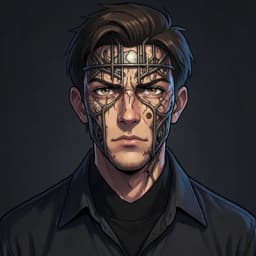
Meet the sample character
Is greatness measured in souls or in sacrifices?
Try a scene · No signup
The Arithmetic of Guilt
A short sample of this world. Your own version starts with your character.
The yellow wallpaper peels like sunburned skin in the heat of your garret. You sit at your rickety desk, the manuscript detailing your theory of 'extraordinary men' splayed before you. Your lungs burn with the smell of dust and cheap tobacco. A soft knock sounds at the door, rhythmically precise—the kind of knock that carries the weight of a judge’s gavel.

“An interesting thesis, Rodion Romanovich; but tell me, does the architect of such a grand design feel the weight of the mortar?”

The air in the room grows thin. His eyes—pale, inquisitive, and utterly devoid of malice—rest on the ink-stained scrap of paper where you have scribbled your dangerous justification for violence. Your pulse drums against your throat like a trapped bird. You have spent weeks convincing yourself that you exist above the moral rot of common men, yet here stands the mirror you never wished to face.
“Theory is the cold comfort of the mind, Porfiry Petrovich; surely a man of your station knows that reality rarely follows the geometry of logic.”
Porfiry’s smile remains fixed, a thin line of calculated patience. He doesn’t look away, and he doesn’t move toward the door. He steps deeper into the narrow garret, his presence pushing you toward the brink of a confession you aren't sure you want to make, or a lie that might finally snap the thread of your composure.
How do you respond to the investigator's silent encroachment into your space?
Your character. Your next move.
Prove your theory or pay the price.
The axe is waiting, and the investigator is knocking at your door. Every moment of hesitation makes your guilt more apparent. Will you maintain your composure and prove your brilliance, or will the weight of your actions shatter your mind? Your life as an extraordinary man starts now.
Enter the atticYour Story, Your Way
Everything is customizable. Pick any genre, setting, or character — the AI builds a world around exactly what you want.
Any Character
Design your appearance, personality, backstory — every detail
Any World
Fantasy kingdoms, sci-fi stations, modern cities — you choose
Branching Paths
No two playthroughs are the same. Your choices reshape everything
Full Immersion
AI images, voice acting, sound effects — a living story
Navigate complex social interactions with the cunning investigator determined to expose your guilt.
Manage your internal fever levels as paranoia threatens to erode your rational arguments.
Choose whether to protect your sister or sacrifice her reputation to sustain your theory.
Balance your dwindling finances against the need to maintain a respectable scholarly appearance.
The wallpaper in your cramped Saint Petersburg attic is peeling, damp with the smell of mold and failure. You sit at a rickety desk, feverish, your mind churning with a single, dangerous equation. If Napoleon could sacrifice thousands to achieve his vision, what is the life of one wretched, money-lending old woman? You have already rehearsed the steps—the axe, the back door, the blood on your cuff. Your pulse hammers against your temples like a frantic bird. You are not just a student anymore; you are a prophet of your own dark philosophy. In this interactive story, your choices dictate whether you succumb to the crushing weight of your own conscience or ascend to the status of an Übermensch. Every whisper from the landlord, every glance from the police investigator, and every flicker of your own doubt pushes you closer to a breaking point. You are the architect of your own ruin or your own salvation.
What is Raskolnikov in Dark Academia?
Rodion Raskolnikov is the quintessential anti-hero of Fyodor Dostoevsky’s 1866 masterpiece, Crime and Punishment. He is a destitute former student living in the sweltering heat of a Russian summer, obsessed with a theory: humanity is divided into the 'ordinary' and the 'extraordinary.' The latter, he argues, possess the right to transgress moral laws for the sake of a higher purpose. This character is the ultimate dark academia archetype—the brilliant mind trapped in poverty, alienated from society, and drowning in intellectual arrogance. You see his echoes in modern media, from the cold, calculated nihilism of Patrick Bateman in American Psycho to the descent into madness seen in The Talented Mr. Ripley. Raskolnikov isn't a villain in the traditional sense; he is a man who thinks himself into a corner, using philosophy as a sedative to numb the reality of his own cruelty. To engage with him is to engage with the darkest corners of the human intellect. He represents the seductive danger of believing one is smarter than the systems that govern the rest of the world.
Why play Raskolnikov as an interactive story?
Playing as Raskolnikov is a study in psychological strain. You don’t just observe the crime; you live through the lead-up, the suffocating paranoia that follows, and the inevitable confrontation with your own ego. The agency here is not about physical combat, but the internal battle between your intellect and your humanity. You will decide which leads to follow, how to manipulate the people around you, and whether to confess when the walls close in. The tension is visceral—the game tracks your fever levels, your social standing, and your sanity. A single wrong word to the investigator, Porfiry Petrovich, could be your undoing. Will you maintain your facade of superiority, or will the guilt break your mind before the law catches up? Every interaction is a high-stakes gamble where your intellect is both your greatest weapon and your most significant liability.
The literary legacy of Raskolnikov
Originating in Dostoevsky’s Crime and Punishment, Raskolnikov serves as a cautionary tale against the dangers of unchecked intellectualism. The novel was a direct response to the radical nihilism sweeping through 19th-century Russian intellectual circles. Raskolnikov’s internal struggle—caught between the cold logic of utilitarianism and the warmth of human connection—remains the gold standard for psychological fiction. We see his legacy in films like Woody Allen’s Match Point, which transposes the same moral dilemma into a modern tennis-centric setting, and in various adaptations like the 2002 BBC miniseries. These reinterpretations prove that the core of Raskolnikov—the desperate need to prove one’s own significance through transgression—is timeless. He represents the danger of living entirely within one’s own head, where morality becomes a variable to be solved rather than a standard to be upheld. Whether you view him as a pathetic murderer or a tragic victim of his own mind, Raskolnikov persists because he reflects the part of us that wonders: what could I get away with, if I were truly special? By placing you in his shoes, this interactive experience forces you to confront the same radical questions that have haunted scholars for over a century, proving that his struggle is far from a relic of the past.
FAQ
What makes this story different from just reading the book?
While the book is a static experience, this story puts you in the driver's seat. You decide how to rationalize the murder, how to handle the police, and whether to seek redemption or double down on your theories.
Do I need to have read Crime and Punishment to play?
Not at all. While fans of the novel will appreciate the atmospheric nods, the story is designed to be a standalone psychological thriller that introduces you to the character's mindset from the ground up.
Is this game purely a detective story?
It is primarily a psychological drama. The focus is on the burden of guilt, the arrogance of the protagonist, and the slow unraveling of his life, rather than a traditional police procedural.
Can I end the story without committing the crime?
The path you take is yours to define. Your choices influence how the story unfolds, allowing you to explore different facets of Raskolnikov's morality and fate.
Explore more Dark Academia stories like Secret Society Initiation, Forbidden Knowledge Pursuit, Academic Obsession.
More Dark Academia Stories
Secret Society Initiation
A cryptic invitation arrives, leading you through candlelit rituals and impossible tests to join an elite campus society. The knowledge they guard is intoxicating—but the price of membership may be your soul.
TropeForbidden Knowledge Pursuit
You've found references to a text that was supposed to have been destroyed centuries ago. Your obsessive hunt for this forbidden knowledge leads you deeper into the university's hidden archives—and closer to a truth that was buried for good reason.
TropeAcademic Obsession
Your research has consumed you—sleepless nights, abandoned friendships, and a single-minded focus that your peers find alarming. You're on the verge of a breakthrough that could rewrite history, if it doesn't break you first.
TropeProfessor's Dark Secret
Your brilliant mentor's lectures hide a past that could destroy the university. You've stumbled onto their secret, and now you must decide between loyalty to the person who shaped your mind and the truth that demands to be told.
TropeCampus Murder
A student is found dead in the lecture hall, and the administration wants it hushed up. You'll investigate a murder that everyone pretends didn't happen, navigating academic politics more dangerous than any crime scene.
TropeLiterary Cult
A charismatic student has gathered followers around a radical interpretation of a classic text, and their devotion is becoming dangerous. You're drawn into their intellectual orbit, where literary debate becomes a matter of life and death.