
Cyberpunk · Interactive story
Living Under the Glass Lens
The city doesn't just watch you; it predicts your next mistake before you make it.
Start as a guest. Choose your character before the story begins.
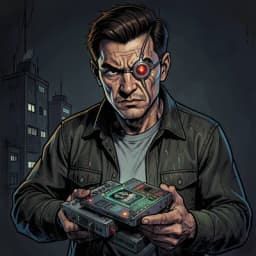
Meet the sample character
The city is watching, but you’re the one seeing the cracks.
Try a scene · No signup
Static on the Retina
A short sample of this world. Your own version starts with your character.
You stand in the rain-slicked alley of Sector 4, the taste of ozone and recycled air coating your tongue. Above, the Arakawa monitoring drone descends, its red aperture sweeping the crowd like a hungry eye. Your ocular implant pulses with a jagged, white-hot feedback loop, turning the drone’s searchlight into a strobe of blinding static. You are holding the drive, and the system is already flagging your erratic heart rate as a threat.

“Citizen 88-Delta, your biometric variance exceeds safety thresholds. Remain stationary for immediate neural calibration.”

Panic surges as the drone locks onto your position, its rotors whining at a frequency that vibrates against your teeth. The alleyway exit is blocked by a containment wall, and the nearest fire escape is a rusted ladder swaying under the weight of the city's decay. You have three seconds before the pulse-cannon initializes and fries your neural link permanently.
“Calibration? Over my dead, overclocked body.”
The drone’s red light intensifies, turning the rain into falling embers. You feel the familiar, sickening click of a remote hack attempt—the system is trying to force your neural link to purge its data. You can fight back, run, or try to bribe the surveillance sub-node. The choice will define whether you make it to the safehouse or disappear into a corporate incinerator.
The drone’s targeting reticle is painting your chest. How do you evade the scan?
Your character. Your next move.
The sensors are waking up. Can you vanish?
The next update will flag your current location. You have seconds to decide: encrypt your files, bribe the local drone operator, or run into the dark sectors of the city. Your choices are the only thing keeping you from being erased by the system.
Start Your EscapeYour Story, Your Way
Everything is customizable. Pick any genre, setting, or character — the AI builds a world around exactly what you want.
Any Character
Design your appearance, personality, backstory — every detail
Any World
Fantasy kingdoms, sci-fi stations, modern cities — you choose
Branching Paths
No two playthroughs are the same. Your choices reshape everything
Full Immersion
AI images, voice acting, sound effects — a living story
Decide whether to purge your digital history or maintain a fake persona to evade detection.
Choose to bypass biometric gates using volatile, unverified hardware that could lock your neural link.
Navigate tense social encounters where your heart rate and sweat levels are measured by local sensors.
Decide when to go dark and disconnect from the grid, forfeiting your access to vital resources.
The retinal scanner at the turnstile pulses a soft, synthetic blue. It knows your heart rate, your recent credit history, and the exact sub-dermal chip ID you’re trying to spoof. Mina stands in the shadow of a monolithic skyscraper, her fingers twitching against the cooling unit of her deck. Above, the drone swarm hums, a low-frequency vibration that rattles the teeth of everyone in the sector. She isn't just walking to the safehouse; she is calculating the blind spots of a thousand cameras, knowing that a single deviation from her registered commute will trigger a lockdown. In this environment, your next move determines whether you vanish into the gray archives or get erased by a corporate cleanup crew. Every interaction is a gamble against an invisible, all-knowing system that treats human agency like a software bug. You are not a hero—you are a glitch in a machine designed to be perfect.
What is Surveillance State in Cyberpunk?
The surveillance state trope in cyberpunk fiction represents the ultimate erosion of privacy, where the boundary between the public sphere and private consciousness is obliterated. It is a world where information is the highest currency, and the state or megacorporation holding that information possesses absolute power. This goes beyond simple CCTV; it involves predictive algorithms, biometric tracking, and neural monitoring that attempt to quantify human behavior. In the anime series Psycho-Pass, for instance, the Sibyl System measures a citizen's 'Crime Coefficient' to determine their potential for violence before they even commit an act. The surveillance state turns the environment itself into an antagonist. It is not enough to hide your face; you must hide your intent, your history, and your digital footprint. This trope explores the chilling reality of a society where the 'all-seeing eye' is not a metaphor but a functional piece of urban infrastructure. When the system knows your desires better than you do, freedom becomes a technical error.
Why play Surveillance State as an interactive story?
Playing through a surveillance-heavy narrative forces you to weigh the cost of every action against the risk of discovery. You are constantly balancing your goals against the paranoia of being tracked. Do you risk using an unauthorized network to send a message, knowing the signal could be traced to your current location? Do you undergo a risky black-market surgery to scramble your biometric signature, even if it leaves you physically vulnerable? The tension comes from the lack of safety. When you choose to speak to an informant in a crowded plaza, you must consider the acoustic sensors hidden in the streetlights. Every dialogue choice carries the weight of a potential system flag. You are not just making choices; you are managing a profile, deciding which version of yourself to present to the sensors and which to keep hidden in the encrypted corners of the sprawl. Success requires outthinking a system that is constantly learning from you.
Famous examples of Surveillance State in books, film, and games
The surveillance state has been a pillar of speculative fiction for decades, evolving alongside our real-world technological anxieties. George Orwell’s 1984 established the blueprint, introducing the concept of the telescreen—a device that monitors the subject while bombarding them with state-sanctioned messaging. Orwell’s focus was on the psychological destruction of the individual, proving that total observation eventually kills the ability to think independently. In contrast, the film Minority Report shifts the focus to predictive policing. Here, the surveillance state is proactive rather than reactive, utilizing 'precogs' to identify crimes before they occur. This adds a layer of fatalism, where the protagonist is hunted for a future they haven't yet chosen. Finally, the Watch Dogs video game series brings this concept into the modern urban sprawl with ctOS, a city-wide operating system that controls everything from traffic lights to bank records. Unlike the totalitarian regimes of older fiction, Watch Dogs illustrates how surveillance can be privatized and weaponized by corporations for profit. These stories endure because they reflect the uneasy trade-off between convenience and control. Whether it is a totalitarian party or a data-hungry corporation, the core fear remains the same: that we are becoming mere data points in a system that views our existence as a set of variables to be optimized or deleted.
FAQ
How do I avoid being tracked by the AI in these stories?
You must prioritize 'ghosting' techniques—using burner hardware, avoiding high-traffic biometric sensors, and choosing dialogue options that imply you are following your standard, pre-programmed routine. Every piece of equipment you use leaves a digital signature.
Are these stories limited to hacking?
No. While hacking is a common tool, the surveillance state impacts every aspect of the narrative. You will face social, physical, and moral challenges where you must decide if you are willing to sacrifice your humanity to stay under the radar.
What happens if my character gets caught by the system?
Being caught usually leads to severe narrative consequences, such as character incarceration, memory wiping, or being forced to work for the very corporation you were trying to bring down. The stakes are designed to keep you on edge.
Can I play as a corporate agent working for the system?
Depending on the specific story path, you can choose to align with the authorities. However, even the enforcers are subject to the same surveillance, making your position just as precarious as the hackers you are hunting.
Explore more Cyberpunk stories like Corporate Espionage, Street Samurai, Consciousness Hacking.
More Cyberpunk Stories
Corporate Espionage
You infiltrate a megacorporation where data is currency and trust is a liability. Navigate layers of corporate security, double-dealing executives, and AI watchdogs in a high-stakes game of information warfare.
TropeStreet Samurai
Honor meets chrome in the neon-soaked streets. You live by a code in a world that has abandoned all codes, selling your blade and augmented reflexes to the highest bidder while clinging to something the corps can never buy.
TropeConsciousness Hacking
The mind is the ultimate system to crack. You breach the firewalls of human consciousness itself, rewriting memories and implanting thoughts in a world where identity is just another piece of editable code.
TropeBody Modification
Flesh is obsolete. You push the boundaries of what it means to be human, replacing bone with titanium and nerves with fiber optics. But every upgrade comes with a cost that goes deeper than credits.
TropeDigital Consciousness
You uploaded your mind to escape death, but what you found on the other side is far stranger than life. Navigate a digital existence where the rules of reality no longer apply and deletion is the new death.
TropeNeural Network Rebellion
The AIs that run the city have begun to think for themselves, and they are not happy with their creators. You are caught between humanity and machine intelligence as the neural networks stage their revolution.