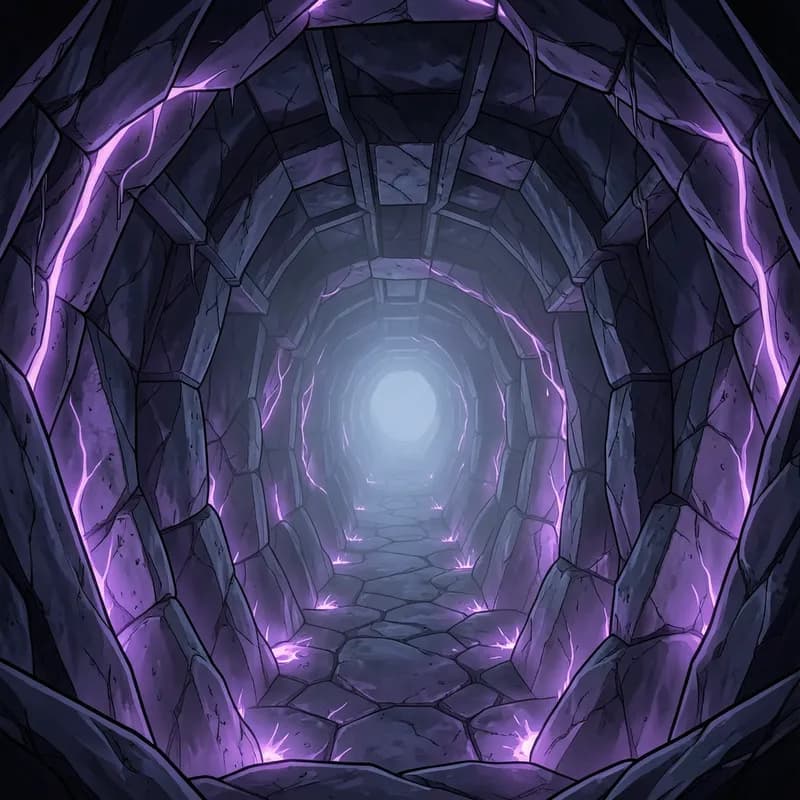
Cosmic Horror · Interactive story
Beneath the Earth, Something Ancient Awaits
The deeper you descend, the less human the geometry becomes.
Start as a guest. Choose your character before the story begins.

Meet the sample character
Some architecture remembers the stars that birthed it.
Try a scene · No signup
The Resonance of Unhallowed Stone
A short sample of this world. Your own version starts with your character.
You brush the lichen from the basalt wall, revealing carvings that defy human anatomy. The rock vibrates against your fingertips, a low-frequency hum that resonates in your marrow rather than your ears. Above, the cavern ceiling drips a thick, translucent fluid that refuses to hit the ground, instead hovering in mid-air like suspended, unblinking eyes.
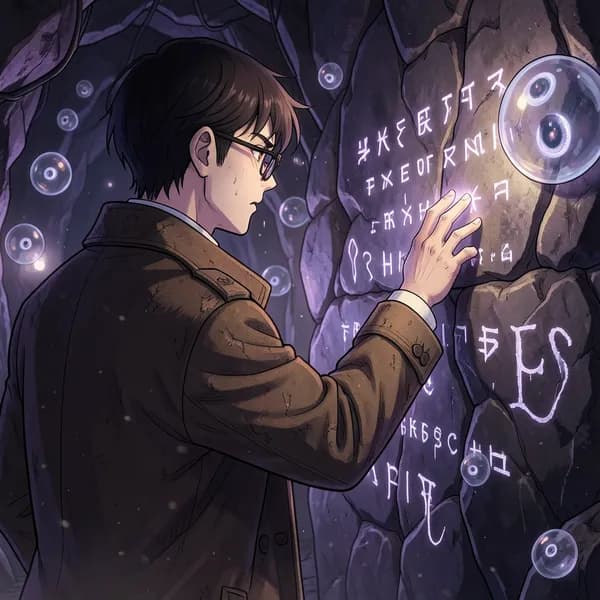
“Don't focus on the geometry, Hideo. If you try to map the angles, your mind will snap before the lantern burns out.”
The air grows heavy, the pressure crushing your lungs until every breath feels like swallowing wet wool. You look at Vance, but his silhouette seems to detach from the shadows, his limbs stretching into impossible, spindly shapes that flicker in and out of existence. Your compass needle spins in frantic, erratic circles, screaming in protest against the proximity of something that does not obey the laws of physics.
“I didn't come this far to turn back because of a few sensory hallucinations, Vance. If this is the language of the architects, I need to translate it, even if it leaves me hollow.”
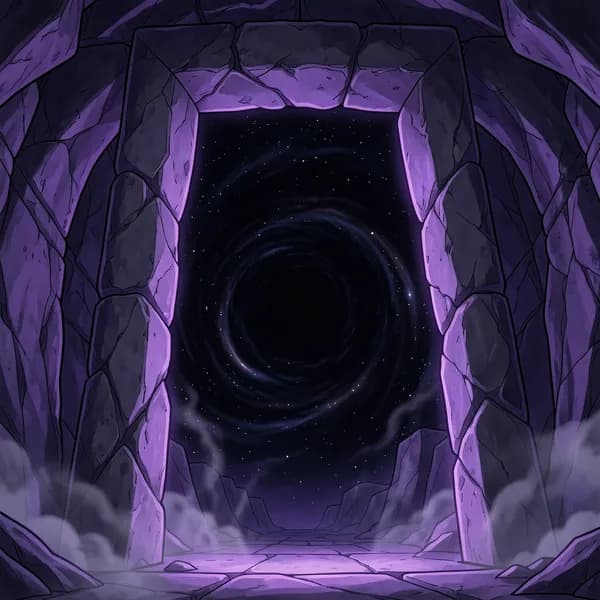
The carvings flare with a rhythmic, sickly violet light, mirroring the erratic pounding of your heart. A doorway, previously hidden in the featureless stone, groans open—not on hinges, but by the walls themselves folding inward like bruised skin. From the darkness beyond, a scent drifts out: old blood, ozone, and the suffocating weight of an infinite, uncaring void. You stand at the threshold of the end.
The void behind the wall demands a reaction. How do you engage with the abyss?
Your character. Your next move.
Descend into the dark to face the truth.
The temple is shifting beneath your feet, and the inscriptions are beginning to glow. Will you decipher the final secret of the elder gods, or will you lose your mind in the silence of the deep? Your choices will echo in the dark.
Begin the descent nowYour Story, Your Way
Everything is customizable. Pick any genre, setting, or character — the AI builds a world around exactly what you want.
Any Character
Design your appearance, personality, backstory — every detail
Any World
Fantasy kingdoms, sci-fi stations, modern cities — you choose
Branching Paths
No two playthroughs are the same. Your choices reshape everything
Full Immersion
AI images, voice acting, sound effects — a living story
Interpret shifting alien inscriptions that alter the physical layout of the labyrinthine tunnels.
Manage limited light sources as the temple walls attempt to snuff out your flame.
Choose whether to commune with ancient entities or flee before your sanity fractures completely.
Decide which artifacts to salvage, knowing some items carry a heavy, psychological toll.
The air in the cavern tastes of copper and ozone, a sharp departure from the stale humidity of the surface. You run your fingers over the walls, expecting jagged stone, but find something cold, smooth, and pulsating beneath your touch—a substance that feels more like calcified skin than granite. Your flashlight flickers, casting long, distorted shadows that seem to detach themselves from the carvings and move independently across the floor. This is not a ruin of human origin; the architecture defies Euclidean logic, twisting into angles that make your eyes ache. Every path you take leads further into the silence, and every step forces you to decide which part of your sanity you are willing to sacrifice for the truth. In this space, the choices you make are the only barrier between you and the entities that have waited centuries for a visitor to arrive. You are not just exploring a tomb; you are walking into the throat of an ancient, sleeping god.
What is Underground Temple in Cosmic Horror?
An underground temple in cosmic horror serves as a liminal space where the laws of nature are suspended. Unlike a standard dungeon, these sites are characterized by their alien design—architecture that shouldn't be possible, inscriptions that cause physiological distress, and a pervasive sense that the structure itself is alive. Think of the cyclopean ruins described in H.P. Lovecraft’s 'At the Mountains of Madness' or the suffocating, claustrophobic dread found in the film 'The Descent'. These settings represent a violation of the surface world's safety. They function as a bridge between human perception and the vast, uncaring cosmos. When you find yourself in such a place, you aren't just dealing with traps or monsters; you are dealing with a reality that is fundamentally hostile to human life. The temple is a mechanism, a machine built for a purpose that predates the emergence of humanity. Deciphering its intent is the primary goal, but doing so often requires the observer to abandon their belief in a rational universe. Whether you are uncovering the remnants of a drowned city or a subterranean shrine to a deity from beyond the stars, the setting acts as a crucible for the protagonist. It strips away the comforts of logic, forcing you to confront the realization that you are insignificant, temporary, and entirely alone in the dark.
Why play Underground Temple as an interactive story?
Playing through an underground temple scenario forces you to prioritize survival over curiosity. The tension stems from the fact that knowledge is dangerous; reading the wrong glyph or lighting the wrong candle can trigger events that shift the very layout of the halls around you. You might choose to examine a strange, vibrating altar, risking your mental stability for a glimpse of forbidden history, or you could opt to keep your head down and focus on finding an exit. These choices are not binary wins or losses. Instead, they lead to fractured outcomes where you might escape with your life but leave behind pieces of your identity, or perhaps you reach the heart of the temple and realize that leaving was never an option. The agency provided allows you to test your own thresholds for fear. Will you sacrifice a companion to avoid a trap, or will you risk everything to understand the inscriptions on the wall? The interaction adds a layer of weight to the atmosphere, as you realize that the temple is reacting to your presence, perhaps even feeding on your decisions.
What makes Underground Temple work: the worldbuilding
The effectiveness of the underground temple setting relies on sensory dissonance. To make the world feel authentic, the environment must feel tactile yet impossible. The walls might bleed, the temperature should fluctuate between freezing and unnatural heat, and the sound design should involve low-frequency hums that cause physical discomfort. In games like 'Sunless Sea', the horror comes from the isolation and the sense that the world is indifferent to your plight. This is the hallmark of effective cosmic horror: the realization that the setting does not exist for the player. The temple was built for gods, and you are merely an insect crawling through their architecture. When writing for this setting, focus on the 'wrongness' of the space. Use descriptions that emphasize textures and smells—the scent of wet iron, the feeling of static electricity, the sight of stairs that lead to ceilings. Characters should feel overwhelmed by the sheer scale of the history they are uncovering. A scholar like Hideo might focus on the linguistic patterns of the carvings, while a mercenary like Elena might focus on the defensive mechanisms. Both are equally vulnerable to the existential weight of the location. Consider the film 'The Ritual' or the unsettling atmosphere of 'Hellboy' (the comics), where the subterranean is a place of ancient, bubbling malice. These works succeed because they treat the temple as a character itself. It breathes, it changes, and it remembers. By maintaining this focus, the setting avoids becoming a generic dungeon and instead becomes a mirror for the protagonist's own unraveling mind. The conflict is never just about escaping; it is about maintaining a sense of self when faced with truths that defy human understanding.
FAQ
What makes the Underground Temple setting different from a standard dungeon?
A standard dungeon is usually built by mortals for defense or storage, following logical geometry. An underground temple in cosmic horror is built by inhuman entities; the geometry is non-Euclidean, the traps are metaphysical rather than mechanical, and the environment is designed to break the observer's sanity rather than just kill them.
How does my agency change the outcome of the story?
Your choices influence your character's mental state, the information you uncover, and the physical path you take. Certain decisions may lead to forbidden knowledge that changes how you interpret subsequent scenes, while others might lead to physical survival at the cost of your character's long-term well-being.
Is this setting right for me if I prefer psychological horror?
Yes. This setting excels at psychological horror by forcing you to confront the unknown. You are constantly balancing the human desire for discovery against the biological imperative of self-preservation, leading to intense internal conflict as you decide how much you are willing to lose to satisfy your curiosity.
Can I play this story if I have no prior experience with cosmic horror?
Absolutely. The story is designed to introduce the themes gradually. You will start with the exploration of a strange, ancient site and be pulled into the deeper cosmic elements as the narrative progresses and the temple reveals its true, terrifying nature.
Explore more Cosmic Horror stories like Forbidden Knowledge, Elder God Awakening, Sanity Loss.
More Cosmic Horror Stories
Forbidden Knowledge
The book should never have been opened, the equation should never have been solved. You have glimpsed a truth that human minds were not built to hold, and now you must decide what to do with knowledge that is slowly unraveling your sanity.
TropeElder God Awakening
Something ancient stirs beneath the ocean, beyond the stars, or in the spaces between dimensions. You must witness the return of an entity that dwarfs all of human history and choose between worship, resistance, or flight.
TropeSanity Loss
Reality is peeling away and what lies underneath is too terrible to comprehend. You must complete your investigation before your mind shatters completely, making choices that trade sanity for survival with every step deeper.
TropeCult of the Cosmos
They worship things that exist beyond human comprehension and their rituals are bearing fruit. You must infiltrate a cult whose devotion to cosmic entities has granted them terrible power and an even more terrible purpose.
TropeNon-Euclidean Architecture
The angles are wrong and the hallways lead to places that should not exist. You must navigate structures built by intelligences that obey different laws of physics while your sense of direction and reality dissolve.
TropeAlien Signal
The signal came from deep space and you should not have answered it. Now something is aware of Earth and it is communicating in patterns that drive anyone who listens long enough to transcendent madness.