
Cosmic Horror · Interactive story
The Architecture of Insanity: Exploring the Sunken City
Geometric impossibilities wait beneath the waves, hungry for the light of your mind.
Start as a guest. Choose your character before the story begins.
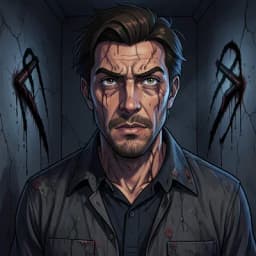
Meet the sample character
Some depths are not meant to be charted.
Try a scene · No signup
The Lithic Singularity
A short sample of this world. Your own version starts with your character.
You drift in the crushing dark, the reinforced glass of your submersible straining against the weight of three miles of black water. Below, the city stretches out—not built, but grown from obsidian, with angles that hurt your eyes to track. Bioluminescent moss pulses in rhythmic patterns, mimicking a slow, steady heartbeat. The sonar has gone silent, replaced by a low-frequency hum that vibrates deep within your teeth.

“The internal pressure gauge is ticking backward, Julian. This place... it isn't physics anymore.”

You look at the dials, and he is right. The needle is spinning, not losing pressure, but reversing through the numbers into impossible territory. Outside, a shadow detaches itself from a cyclopean pillar. It is too large to be an animal, too fluid to be stone, and it is moving directly toward your observation window. The glass begins to frost from the inside, forming patterns that resemble ancient, forgotten alphabets.
“Steady your hands, Aris. If we turn back now, we lose everything. We have to see what is waiting in the dark.”
The shadow presses against the glass, and for a heartbeat, you realize it has no face, only a single, weeping aperture that reflects your own eyes back at you. The air in the sub grows heavy, smelling of ozone and stagnant centuries. You have to decide: do you vent the ballast to flee, open the hatch to invite the entity in, or trigger the emergency flare to burn the darkness away?
The entity is pressing against the glass, its gaze forcing a choice between madness and survival. How will you respond?
Your character. Your next move.
Will you escape the abyss with your sanity intact?
The pressure is rising, and the walls are shifting. You have found a strange, pulsing artifact in the ruins—do you take it to the surface, or leave it to the gods who built this tomb? Your choices decide whether you return to the world of men or become another ghost in the deep. Start your story now.
Begin your descentYour Story, Your Way
Everything is customizable. Pick any genre, setting, or character — the AI builds a world around exactly what you want.
Any Character
Design your appearance, personality, backstory — every detail
Any World
Fantasy kingdoms, sci-fi stations, modern cities — you choose
Branching Paths
No two playthroughs are the same. Your choices reshape everything
Full Immersion
AI images, voice acting, sound effects — a living story
Choose whether to prioritize oxygen conservation or investigating alien, sanity-blasting inscriptions.
Decide if you will open a rusted airlock, knowing something ancient waits on the other side.
Manage your character's dwindling sanity as the city's non-Euclidean geometry warps your perspective.
Navigate flooded tunnels where every sound you make alerts the things living in the dark.
The pressure at the bottom of the trench is not just water; it is a physical weight of expectation. Your submarine’s sonar pings, but the sound does not echo back—it returns distorted, as if the structures ahead are absorbing the vibration to feed some subterranean metabolism. Ahead, the outline of a spire rises, built at angles that make your eyes twitch and your stomach churn. This is a place where human logic goes to die. You stand at the airlock, hearing the groaning of metal, and realize that stepping out means accepting that everything you know about physics is a lie. Your choices determine whether you reclaim your sanity or succumb to the siren song of the drowned gods. Every path you take leads further from the surface and deeper into an ancient, liquid nightmare that has waited for eons to be disturbed.
What is Sunken City in Cosmic Horror?
The Sunken City trope represents the ultimate intersection of human fragility and the vast, uncaring nature of the cosmos. It is a setting where the rules of reality are fluid, literally and figuratively. Rooted in the works of H.P. Lovecraft, most notably in 'The Call of Cthulhu' with the nightmarish R'lyeh, this setting posits that humanity is merely a brief flicker in the history of the earth. These ruins are never human; they are built by precursors whose biology and aesthetic preferences are incomprehensible to our limited senses. We see echoes of this in modern media, such as the claustrophobic, resource-starved dread of the film 'Underwater' or the decaying, art-deco madness of the underwater city in the video game 'BioShock.' Unlike a haunted house or a slasher flick, the Sunken City does not want to kill you out of malice. It ignores you, and that indifference is what makes it so terrifying. When you explore these ruins, you are not a hero on a quest; you are a trespasser in a graveyard of gods, walking through halls that were never meant to be lit by a human lantern.
Why play Sunken City as an interactive story?
Playing a narrative set in a Sunken City forces you to confront the cost of curiosity. In a standard book, you watch the protagonist lose their mind; here, you make the decisions that lead to that breakdown. You will face moments where you must choose between repairing your oxygen supply or documenting a wall of carvings that seem to move when you turn your head. Do you trust the radio signals coming from the dark, or do you cut the power to ensure whatever is calling you stays silent? Agency adds a layer of dread that static media cannot replicate. Every action you take has a consequence on your character’s mental stability. You might find a heavy, ornate key, but picking it up might trigger a sensory hallucination that leaves you disoriented in the dark. The game tracks your choices, meaning the city reacts to your presence, slowly closing off exits or revealing passages that were not there a moment ago. Your survival depends on recognizing when to stop looking and when to run, even when the path behind you has vanished.
What makes Sunken City work: the worldbuilding
The effectiveness of the Sunken City lies in sensory dissonance. To build a truly terrifying environment, the narrative must emphasize the feeling of being somewhere that defies the laws of nature. The architecture should be described as 'wrong'—stairs that lead to nowhere, angles that hurt to look at, and materials that feel like obsidian but pulse like flesh. This is the essence of cosmic horror: the realization that the universe is larger and stranger than we are equipped to handle. In the game 'Amnesia: The Dark Descent,' the player experiences a similar crushing weight of isolation, while the film 'The Deep' captures the claustrophobic terror of being trapped in a place that wants to erase you. To succeed in writing or playing this setting, focus on the details that suggest a larger, darker history. Do not explain the gods; describe the shadows they cast. Do not define the monsters; describe the sound of their movement through the pipes. The characters who belong here are usually academics, salvage divers, or desperate scavengers—people who think they are prepared for the truth, only to find that the truth is a weight they cannot carry. By focusing on the environmental storytelling—the salt-crusted journals, the leaking pipes, the bioluminescent moss that seems to watch you—you build a world that feels both ancient and aggressively alive. The goal is not to defeat the city; the goal is to survive long enough to remember why you wanted to leave.
FAQ
What makes the Sunken City setting different from a standard horror game?
Standard horror often relies on jump scares or physical threats. The Sunken City setting focuses on existential dread, the corruption of sanity, and the realization that the environment itself is hostile to human life. It is about the terror of the unknown rather than a chase.
How does the interactive element affect the horror?
Because you are making the choices, the responsibility for your character's fate rests on you. When you decide to investigate a strange noise, you feel the tension of that decision, making the resulting consequences feel personal and earned.
Is this setting suitable for players who prefer action-heavy stories?
While there are moments of high tension and survival, this setting is best for those who enjoy slow-burn mystery and psychological horror. If you appreciate building atmosphere and uncovering lore through observation, you will find it highly engaging.
Can I play as different types of characters in the Sunken City?
Yes, you can define your character's background. A scientist will perceive the ruins through a lens of logic and observation, while a salvage diver might focus on survival and practical navigation, changing how the story responds to your actions.
Explore more Cosmic Horror stories like Forbidden Knowledge, Elder God Awakening, Sanity Loss.
More Cosmic Horror Stories
Forbidden Knowledge
The book should never have been opened, the equation should never have been solved. You have glimpsed a truth that human minds were not built to hold, and now you must decide what to do with knowledge that is slowly unraveling your sanity.
TropeElder God Awakening
Something ancient stirs beneath the ocean, beyond the stars, or in the spaces between dimensions. You must witness the return of an entity that dwarfs all of human history and choose between worship, resistance, or flight.
TropeSanity Loss
Reality is peeling away and what lies underneath is too terrible to comprehend. You must complete your investigation before your mind shatters completely, making choices that trade sanity for survival with every step deeper.
TropeCult of the Cosmos
They worship things that exist beyond human comprehension and their rituals are bearing fruit. You must infiltrate a cult whose devotion to cosmic entities has granted them terrible power and an even more terrible purpose.
TropeNon-Euclidean Architecture
The angles are wrong and the hallways lead to places that should not exist. You must navigate structures built by intelligences that obey different laws of physics while your sense of direction and reality dissolve.
TropeAlien Signal
The signal came from deep space and you should not have answered it. Now something is aware of Earth and it is communicating in patterns that drive anyone who listens long enough to transcendent madness.