
Cosmic Horror · Interactive story
Frozen Secrets: An Antarctic Cosmic Horror Expedition
The wind howls, but something beneath the ice is screaming louder.
Start as a guest. Choose your character before the story begins.
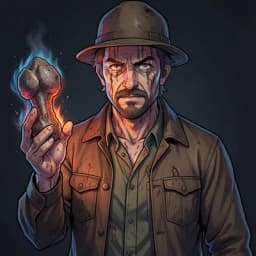
Meet the sample character
Some things are buried for a reason.
Try a scene · No signup
The Geometry of Ice
A short sample of this world. Your own version starts with your character.
You stare at the core sample extracted from the deep shaft. It is not stone. It is a translucent, hexagonal lattice that hums with a frequency your teeth can feel. The blizzard screams against the canvas of your tent, but the sound inside is steady, rhythmic, and wet, like a pulsing heart buried under ten thousand years of pressure.

“The drill snapped, Vane. Whatever this is, it didn't want the teeth of the machinery biting its flank. We need to leave before the storm seals the path.”

You look at the ice floor beneath your boots. A pattern of non-Euclidean angles is bleeding through the white, glowing with a sickly, violet hue that defies the laws of optics. The frost on your gloves is melting into black, oily droplets despite the sub-zero air. The shadows in the corner of the tent are stretching, detaching themselves from the canvas as if the light itself is terrified.
“It isn't a fossil, Soren. It is waiting for us to stop fighting the cold so it can finally wake up.”
A heavy, rhythmic thudding vibrates from deep beneath the ice, rattling your very marrow. The violet light in the floor flares, blinding you for a split second, and the tent fabric begins to tear not from the wind, but from unseen hands reaching through from the other side. You are the only person who knows what is about to crawl into this reality.
The ground is fracturing beneath you as the barrier between dimensions fails. What is your next move?
Your character. Your next move.
The ice is shifting. Will you survive the night?
The radio is dead, and the shadows are closing in. Every minute you wait is a minute the temperature drops. Will you seal the bulkhead and pray for rescue, or venture out into the blizzard to see what is knocking on the station walls? Your choices determine who makes it home.
Begin Your Antarctic ExpeditionYour Story, Your Way
Everything is customizable. Pick any genre, setting, or character — the AI builds a world around exactly what you want.
Any Character
Design your appearance, personality, backstory — every detail
Any World
Fantasy kingdoms, sci-fi stations, modern cities — you choose
Branching Paths
No two playthroughs are the same. Your choices reshape everything
Full Immersion
AI images, voice acting, sound effects — a living story
Choose whether to trust the erratic readings of your instruments or your own deteriorating senses.
Decide how to distribute limited medical supplies when your crew begins exhibiting strange, unexplainable symptoms.
Select which sector of the ruins to explore, knowing each path leads to different catastrophic discoveries.
Determine if you will attempt to signal for help, risking the exposure of your location to unknown entities.
The barometer has been dropping for three days, but that isn't what keeps Dr. Aris awake at night. Outside the reinforced glass of the research station, the Antarctic plateau is a flat, white void stretching toward an impossible horizon. You stare at the seismic readout, watching the jagged lines form patterns that defy Euclidean geometry. A low-frequency hum vibrates through the floorboards, matching the frantic rhythm of your own pulse. The radio went silent hours ago, leaving you and your crew isolated in a place where the laws of physics seem to have lost their grip. In this interactive story, your survival depends on what you choose to prioritize when the rations run low and the shadows in the corner of the lab begin to move independently of the light. Every decision you make carries weight, shifting the trajectory of your expedition as the blizzard outside intensifies. You are the only thing standing between the discovery of a lifetime and an encounter with a terror that humanity was never meant to witness.
What is Antarctic Expedition in Cosmic Horror?
The Antarctic expedition setting functions as a crucible for isolation and existential dread. By stripping away the comforts of modern civilization and placing characters in a landscape that is fundamentally hostile to life, the genre forces a confrontation with the vast, uncaring nature of the universe. In this setting, the cold is not just a weather condition; it is a physical barrier that prevents escape, ensuring that the characters must face whatever ancient, eldritch threat they have unearthed. H.P. Lovecraft’s novella 'At the Mountains of Madness' remains the gold standard for this trope, detailing the discovery of cyclopean ruins and the remnants of a pre-human civilization that renders human history insignificant. Similarly, John Carpenter’s film 'The Thing' utilizes the Antarctic backdrop to heighten paranoia, showing how a shapeshifting, extraterrestrial entity can dismantle a tight-knit group from within. These stories thrive on the tension between academic curiosity and the instinctual, primal fear that some doors should never be opened. When you step onto the ice in an Antarctic cosmic horror story game, you are walking into a space where human logic fails, and the environment itself feels like a predator waiting for you to slip.
Why play Antarctic Expedition as an interactive story?
Playing through an Antarctic expedition allows you to dictate the pace of the inevitable decline. Unlike a static film or book, your agency drives the investigation, meaning you decide how much forbidden knowledge is worth the cost of your sanity. Will you prioritize the safety of your crew, or will you succumb to the siren call of the anomalies buried beneath the ice? You will face moments where the equipment fails, and you must choose between repairing the heater or saving your journals. You might encounter a journal from a previous expedition that details their descent into madness, and you will have to decide whether to read it or burn it. The tension is heightened by the realization that your choices directly affect your ability to detect the approaching threat. If you spend too much time analyzing the artifacts, you might miss the signs that the perimeter has been breached. The interactive nature of the medium turns every decision into a gamble, forcing you to weigh the pursuit of truth against the biological necessity of staying alive.
What makes Antarctic Expedition work: the worldbuilding
The effectiveness of an Antarctic expedition story relies on the interplay between extreme environmental constraints and the psychological unraveling of the characters. The worldbuilding must emphasize the sensory deprivation of the polar wastes—the blinding white light, the rhythmic, maddening sound of a wind that never ceases, and the pervasive metallic smell of ozone and old blood. Conflicts arise naturally from the clash between scientific rationalism and the inexplicable phenomena that defy it. A geologist might try to explain a non-Euclidean sculpture as a natural formation, while a radio operator begins to hear voices in the static. These character archetypes—the skeptic, the obsessive researcher, the pragmatic survivor—provide a stable baseline that makes the eventual breakdown more impactful. Real-world works like 'The Terror' by Dan Simmons, while set in the Arctic, masterfully utilize this same 'trapped in the ice' mechanic to show how social structures dissolve when survival becomes the only goal. Similarly, the game 'Dead Space 3' on the frozen planet Tau Volantis captures the visual horror of ancient, alien architecture half-buried in glaciers. To make this setting work, the narrative must treat the environment as a character in its own right. The ice is ancient, indifferent, and hungry. It does not care about your mission, your degrees, or your life. By focusing on the small, tactile details—the frost creeping up the inside of a helmet, the way a flashlight beam fails to penetrate the absolute darkness of a cavern—the story creates a foundation of grounded reality that makes the cosmic horror elements feel truly invasive and terrifying.
FAQ
How does sanity impact gameplay in this Antarctic story?
Sanity functions as a hidden resource. As you witness incomprehensible events, your character's perception of reality may shift, leading to unreliable narration. High sanity allows for clearer logical deductions, while low sanity may reveal hidden, unsettling details that others miss, though at the risk of losing control over your actions.
Is this story inspired by H.P. Lovecraft?
Yes. The setting draws heavily from the themes of cosmic indifference and ancient, pre-human civilizations central to Lovecraftian horror. You will find echoes of 'At the Mountains of Madness' throughout the expedition, particularly in the discovery of ruins that predate human evolution.
Can I save my progress during the expedition?
Yes, your progress is tracked automatically. Every choice you make is recorded, allowing you to return to the expedition and see how your past decisions influence the current state of your crew and the station.
What happens if I make the 'wrong' choice?
There is no single correct path in this Antarctic horror interactive story. A wrong choice might lead to the loss of a crew member, the destruction of vital equipment, or a faster encounter with the unknown. However, these outcomes are part of the story, creating unique branches that define your specific experience.
Explore more Cosmic Horror stories like Forbidden Knowledge, Elder God Awakening, Sanity Loss.
More Cosmic Horror Stories
Forbidden Knowledge
The book should never have been opened, the equation should never have been solved. You have glimpsed a truth that human minds were not built to hold, and now you must decide what to do with knowledge that is slowly unraveling your sanity.
TropeElder God Awakening
Something ancient stirs beneath the ocean, beyond the stars, or in the spaces between dimensions. You must witness the return of an entity that dwarfs all of human history and choose between worship, resistance, or flight.
TropeSanity Loss
Reality is peeling away and what lies underneath is too terrible to comprehend. You must complete your investigation before your mind shatters completely, making choices that trade sanity for survival with every step deeper.
TropeCult of the Cosmos
They worship things that exist beyond human comprehension and their rituals are bearing fruit. You must infiltrate a cult whose devotion to cosmic entities has granted them terrible power and an even more terrible purpose.
TropeNon-Euclidean Architecture
The angles are wrong and the hallways lead to places that should not exist. You must navigate structures built by intelligences that obey different laws of physics while your sense of direction and reality dissolve.
TropeAlien Signal
The signal came from deep space and you should not have answered it. Now something is aware of Earth and it is communicating in patterns that drive anyone who listens long enough to transcendent madness.