Arabian Nights · Interactive story
The Burden of the Gilded Throne
Gold glitters, but steel protects the crown. Will you rule with iron or silk?
Start as a guest. Choose your character before the story begins.

Meet the sample character
Truth is a bitter draft when poured by a traitor.
Try a scene · No signup
The Salted Cup of Al-Qasr
A short sample of this world. Your own version starts with your character.
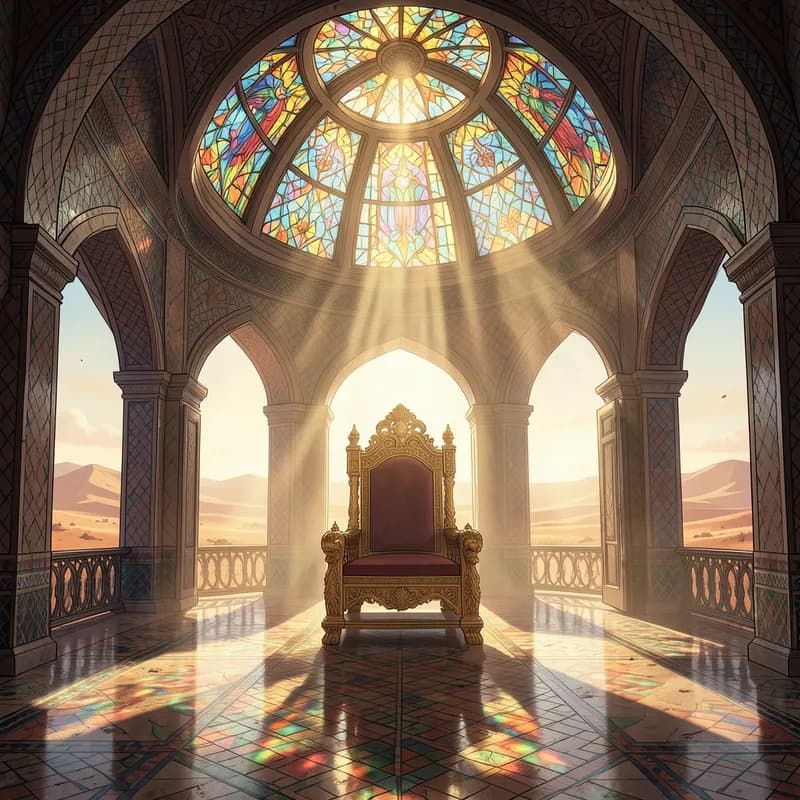
The heat presses against the stained glass, turning the throne room into an oven of gilded misery. You watch the Vizier Zayd, his fingers long and yellowed like parchment, glide toward your dais. He carries a silver flagon, the heavy scent of crushed jasmine masking the faint, metallic tang of something sharper.

“A cooling draught for a weary king, sire. The desert winds hold no mercy for those who govern with hesitation.”

You track the movement of his sleeve. The palace guards are silent, their eyes fixed on the cold mosaic floor as if they fear to witness their master’s collapse. You know the water in that pitcher comes from the sacred cistern, the one the rebels claim has been tainted by your own recent edicts.
“Drink first, Zayd. If it clears the throat of a viper, it shall surely soothe the tongue of a king.”
Zayd pauses, his smile thinning to a razor’s edge. The flagon trembles, just enough to catch the light. You realize your own guards are watching, their hands hovering near their scimitars, waiting for you to name a traitor or share a cup that might end your reign before the sun sets.
The Vizier holds the silver flagon steady, but sweat beads on his brow. How do you force his hand?
Your character. Your next move.
Reign over your golden empire.
The vizier waits for your command. Will you sign the decree that saves the city, or will you let the shadows consume your court? Your throne awaits those bold enough to seize it.
Take the ThroneYour Story, Your Way
Everything is customizable. Pick any genre, setting, or character — the AI builds a world around exactly what you want.
Any Character
Design your appearance, personality, backstory — every detail
Any World
Fantasy kingdoms, sci-fi stations, modern cities — you choose
Branching Paths
No two playthroughs are the same. Your choices reshape everything
Full Immersion
AI images, voice acting, sound effects — a living story
Decide the fate of political prisoners without knowing who truly holds the dagger.
Allocate gold reserves between temple renovations, military expansion, or famine relief efforts.
Navigate the dangerous dance of court diplomacy during lavish, tension-filled royal banquets.
The scent of jasmine and burning frankincense clings to the silk tapestries of your private chamber. Outside, the city hums with the restless energy of a million souls, but within these walls, silence is your only companion. A messenger kneels at your feet, his forehead pressed against the cool marble, trembling as he delivers news of a rebellion brewing in the outer provinces. You have a quill in one hand and a signet ring in the other. One gesture brings prosperity; the other brings blood. In this story, your decisions carry the weight of a dynasty. Every word you speak ripples through the gilded halls of the palace, changing the fate of those who serve you and those who plot your downfall.
What is The Sultan in Arabian Nights?
The Sultan is a figure defined by isolation and absolute authority. This archetype sits at the center of a web, balancing the demands of a sprawling empire against the personal cost of maintaining a crown. In classic literature like The Thousand and One Nights, the Sultan is often the catalyst for the narrative—a ruler whose temperament dictates the safety of his subjects. Think of Shahryar, whose grief-stricken rage sets the stage for Scheherazade’s tales, or the distant, imposing rulers seen in the Prince of Persia games or the historical drama The Magnificent Century. This character is not merely a figurehead; they are a pivot point. Whether portrayed as a benevolent protector or a paranoid tyrant, the Sultan archetype explores how power distorts one’s perception of reality. It is a role of constant vigilance, where the line between a loyal vizier and a hidden assassin is often drawn in shadows.
Why play The Sultan as an interactive story?
Playing as a Sultan shifts the focus from the hero’s journey to the ruler’s burden. You aren't just fighting monsters; you are managing the health of a kingdom. You will face moments where the correct choice isn't clear. Do you execute a brilliant but arrogant general to prevent a coup, losing your best defense against invaders? Do you tax the merchant guilds to fund the poor, knowing the famine will spark a riot? The tension stems from the fact that everyone wants something from you. Your agency lies in how you handle these competing interests. You might choose to be a patron of the arts, inviting dangerous poets to your court, or a master of espionage, using your network of spies to root out dissent before it reaches your ears.
The psychology of The Sultan: why readers fall for this character
The Sultan archetype taps into the primal fantasy of absolute control coupled with the crushing fear of betrayal. Humans are fascinated by the Sultan because they represent the ultimate externalization of consequence. In the Sinbad legends, the rulers encountered often serve as mirrors for the protagonist's own greed or humility. Consider the depiction of the Sultan in the Prince of Persia games—a figure often sidelined by catastrophe, emphasizing the vulnerability of the throne despite its apparent strength. Unlike a warrior who solves problems with a blade, the Sultan must solve them with perception. They embody the fear that even with a thousand guards, you are never safe. This archetype activates a desire for impact; we want to see how our choices ripple through a society. It is the thrill of the 'what if' scenario: if the kingdom were yours, would you be the wise judge or the feared despot? The archetype thrives because it forces the player to confront the reality that power demands a sacrifice, usually of one’s own peace of mind.
FAQ
What makes the Sultan archetype different from a typical hero?
A typical hero moves through the world, while a Sultan is the world. Your choices don't just change your own path; they alter the economic, political, and social landscape of your kingdom.
How does the AI handle court intrigue?
The AI tracks the loyalty and hidden agendas of your advisors and subjects. A casual remark or a harsh decree can shift the entire court’s disposition toward you.
Can I lose my kingdom in this story?
Yes. If your choices alienate your generals, bankrupt the treasury, or incite the people, your reign can end in exile or worse.
Is this story historically accurate?
It draws inspiration from the folklore of the Arabian Nights, focusing on the atmosphere, customs, and dilemmas of the era rather than strict textbook history.
Explore more Arabian Nights stories like Djinn Wish, Flying Carpet Ride, Thief in the Palace.
More Arabian Nights Stories
Djinn Wish
A djinn offers you three wishes, and every word you speak matters. Craft your desires carefully, because djinn are ancient, literal, and take a certain pleasure in granting exactly what you asked for in the worst possible way.
TropeFlying Carpet Ride
The carpet lifts and the world falls away beneath you. Soar over moonlit deserts, glittering cities, and seas of sand as the wind carries you toward an adventure that can only be reached from the sky.
TropeThief in the Palace
Slip past guards, dodge enchanted traps, and navigate golden corridors as you steal from the most powerful ruler in the land. Every shadow could hide a guard, every treasure could be cursed, and the real prize might not be what you came to take.
TropeSultan's Challenge
The sultan sets an impossible task: solve the riddle, complete the quest, or face execution at dawn. Your wits are your only weapon as you navigate a challenge designed to humble the proudest and destroy the unprepared.
TropeDesert Caravan Adventure
Join a caravan crossing endless dunes where sandstorms hide djinn, oases appear and vanish, and every fellow traveler has a story more extraordinary than the last. The desert tests everything you are and reveals what you are made of.
TropeEnchanted Lamp
Rub the tarnished lamp and unleash a power that can build empires or destroy them. The lamp chooses its master, the djinn inside has its own agenda, and everyone in the kingdom will kill to possess what you now hold in your hands.