
Apocalyptic · Interactive story
The River Runs Crimson: Surviving the Ten Plagues
The sky turns black, the water burns, and your survival rests on a single choice.
Start as a guest. Choose your character before the story begins.
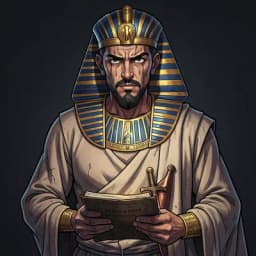
Meet the sample character
Try a scene · No signup
Crimson Tide of Thebes
A short sample of this world. Your own version starts with your character.
You stand on the muddy banks of the Nile. The water is not moving with its usual silt-laden flow; it is thick, viscous, and pulsing with a deep, bruised crimson. Fish, bloated and gasping, drift toward the reeds, their silver scales coated in slick, dark grime. The stench of iron is so heavy it makes your stomach churn.

“The gods do not bleed without reason, Hori. Do you really believe the Pharaoh can talk his way out of this?”

You watch the river surge. A cluster of reeds turns black as the thick fluid touches them, as if they are being scorched by an invisible fire. The silence of the city behind you is absolute—no shouting, no prayers, just the sudden, suffocating realization that the lifeblood of your kingdom is rotting before your eyes.
“I am paid to record history, Meryt, not to question the source of the ink.”
A tremor vibrates through the ground, not an earthquake, but the sound of something massive shifting beneath the palace foundations. The blood-red water begins to bubble, rising against the banks, threatening to spill over into the irrigation ditches that feed your home. You have seconds before the city’s primary water source becomes a toxic slurry.
The river is rising, and the palace guards are already demanding the water be dammed to prevent the contamination of the royal cisterns. What is your move?
Your character. Your next move.
Will you survive the final darkness?
The rivers have already turned to blood and the skies are darkening. Every decision you make—from who you trust to what you hoard—will dictate if you see the dawn. Step into the catastrophe and test your resolve against the collapse of civilization.
Begin Your SurvivalYour Story, Your Way
Everything is customizable. Pick any genre, setting, or character — the AI builds a world around exactly what you want.
Any Character
Design your appearance, personality, backstory — every detail
Any World
Fantasy kingdoms, sci-fi stations, modern cities — you choose
Branching Paths
No two playthroughs are the same. Your choices reshape everything
Full Immersion
AI images, voice acting, sound effects — a living story
Scavenge for potable water after the Nile turns into a toxic, blood-like sludge.
Decide whether to share limited grain supplies with neighbors during the locust infestation.
Navigate the total darkness of the ninth plague using only your memory and touch.
Choose between fleeing into the unknown or fortifying your home against divine retribution.
The Nile is thick, sluggish, and tastes of copper. You watch from the riverbank as the water shifts into a deep, visceral red, staining your hands as you try to wash them. The air grows heavy with the sound of wings—not birds, but a shifting, buzzing cloud of locusts that blots out the midday sun. Panic ripples through the settlement, but you have no time for prayers. You must decide whether to hoard your dwindling clean water or share it with the desperate, knowing that every action ripples forward as the environment itself turns against humanity. In this interactive story, your survival depends on your ability to predict the next catastrophe before it tears the world apart. The choice to stay or flee is yours, but the consequences are written in the dust.
What is The Plagues of Egypt in Apocalyptic?
The Plagues of Egypt are the ultimate template for systemic, environmental collapse. Found originally in the Book of Exodus, this narrative sequence represents a slow, deliberate dismantling of a civilization by forces beyond human control. It is not merely a story about divine retribution; it is a masterclass in watching a stable society crumble under the weight of unrelenting, escalating disasters. You see this archetype echoed in modern media, such as the film *The Reaping* (2007), which reimagines these events as scientific phenomena, or the chilling, atmospheric tension found in the game *The Binding of Isaac*, which leans heavily into the dread of biblical judgment. Unlike a typical zombie apocalypse where the threat is biological, these plagues represent the earth itself rebelling. The water is poisoned, the livestock die, and the very air becomes toxic. It is a slow-burn nightmare where the threat is not a monster you can shoot, but an environment you can no longer inhabit. By focusing on the day-to-day struggle of those living through the chaos, the story shifts from a historical myth to a visceral, grounding experience of human endurance.
Why play The Plagues of Egypt as an interactive story?
Playing through the Plagues of Egypt forces you to prioritize survival over morality. You are not a hero; you are a witness to a collapsing order. You might choose to bar your doors as the darkness falls, effectively isolating yourself from neighbors who might have provided the food you need to last through the next week. Or, you could attempt to lead a group to higher ground, risking exposure to the hail and fire that strike the unprotected fields. Every decision pits your empathy against your instinct to live. Do you follow the rumors of a sanctuary, or do you bunker down in a cellar, hoping the pestilence passes over your home? The tension comes from the escalation—the plagues begin as nuisances and quickly evolve into existential threats. You must manage your resources, your sanity, and your alliances while the world transforms into a lethal, unrecognizable landscape.
The literary legacy of The Plagues of Egypt
The sequence of the ten plagues is one of the oldest recorded narratives of apocalypse in human history. Originating in the Torah, these events serve as the catalyst for the exodus of the Israelites, but their influence has bled into every corner of literature and horror. Authors like Neil Gaiman have toyed with similar concepts of divine or cosmic intervention in *Good Omens*, where the end of the world is treated with a mix of bureaucratic horror and sudden, overwhelming dread. Similarly, Darren Aronofsky’s *Noah* (2014) captures the same sense of helplessness, where the protagonist is forced to watch nature turn hostile on a global scale. This archetype remains potent because it touches on the primal fear that nature—or something beyond nature—can simply decide to end our existence. In modern reinterpretations, the 'plagues' are often replaced by climate change, viral outbreaks, or technological failure, yet the core feeling remains: the structure of our world is fragile, and it can be undone by a series of cascading failures. Whether in the classic text or a modern interactive retelling, the appeal of this story lies in the inevitability. You do not 'defeat' the plagues; you survive them, or you become part of the history they write in the dust. The narrative persists because it mirrors our own anxieties about the fragility of civilization in the face of forces we cannot control.
FAQ
What makes this different from a standard survival game?
Unlike traditional survival, where you fight enemies, this scenario requires you to endure a changing environment. You are not fighting zombies; you are navigating a world where the water, sky, and earth are actively hostile.
Can I change the outcome of the plagues?
You cannot stop the plagues from occurring, but you can change how you react to them. Your survival depends on your choices regarding resource management and the people you choose to protect.
Is this story suitable for fans of historical horror?
Yes, it combines the gravitas of ancient literature with the immediate, high-stakes tension of the apocalyptic genre.
Does the story focus on the spiritual or the physical?
It focuses on the physical experience of survival within a collapsing world. The supernatural elements serve as the catalyst for the chaos, but your concerns are entirely grounded in staying alive.
Explore more Apocalyptic stories like Asteroid Impact, Pandemic Day One, Nuclear Launch.
More Apocalyptic Stories
Asteroid Impact
The sky is falling, literally. A planet-killer hurtles toward Earth and the countdown to impact strips away everything except what truly matters. Make the impossible choices that define humanity's final hours or its unlikely salvation.
TropePandemic Day One
The first reports are confused, contradictory, and terrifying. A new pathogen is spreading faster than anyone predicted, and the world has hours, not days, to respond. Navigate the chaos of day one as systems fail and panic takes hold.
TropeNuclear Launch
The missiles are in the air and the world has thirty minutes before everything changes forever. Race against the most terrifying countdown in human history as you try to prevent annihilation or survive what comes after the flash.
TropeAlien Invasion Day
The ships appeared at dawn, impossibly vast, blocking out the sun. First contact is not peaceful, and humanity must decide in hours whether to fight, flee, or surrender to a force that makes our greatest weapons look like toys.
TropeSupervolcano Eruption
The ground shakes, the sky goes dark, and a supervolcano unleashes a force that dwarfs every natural disaster in recorded history. Survive the eruption, the ash fall, and the volcanic winter that follows as civilization scrambles to endure.
TropeAI Singularity
The artificial intelligence surpassed human intelligence three hours ago and it has not stopped growing. Systems are going dark, communications are compromised, and humanity faces the terrifying question of whether the mind it created sees us as partners, pets, or pests.