Apocalyptic · Interactive story
The Last View from the Top: A Fight for Survival
The city is burning, but you have the only vantage point that matters.
Start as a guest. Choose your character before the story begins.

Meet the sample character
The view from the top is the last thing you will ever see.
Try a scene · No signup
Skyline of Ash
A short sample of this world. Your own version starts with your character.
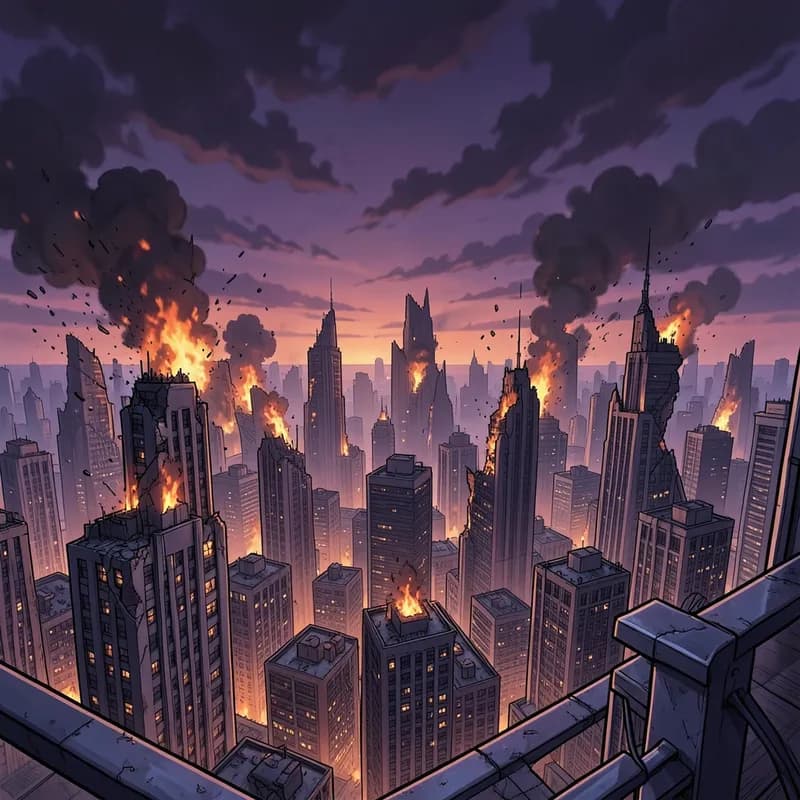
The horizon isn't black; it is a bruised, pulsing purple. Below you, the gridlock has turned into a funeral pyre. You see the flicker of explosions reflected in the glass of the neighboring skyscraper, each bloom of light followed seconds later by a low, vibrating thud that rattles your teeth.
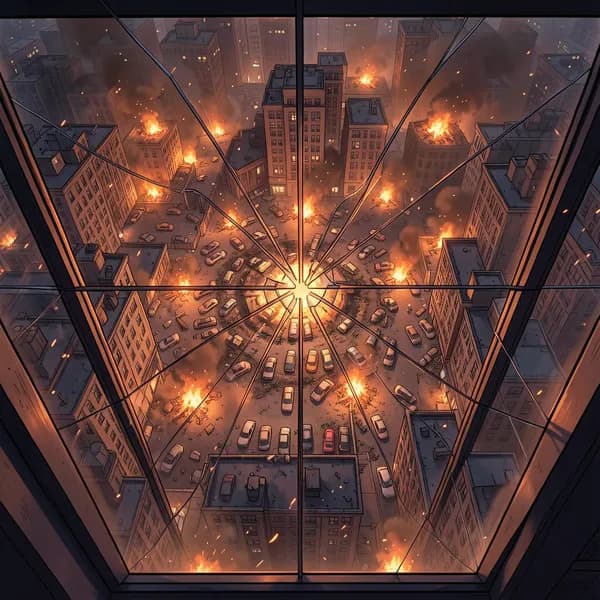
“Stop watching the fires, Joon-ho. They don't care if you see them burn.”
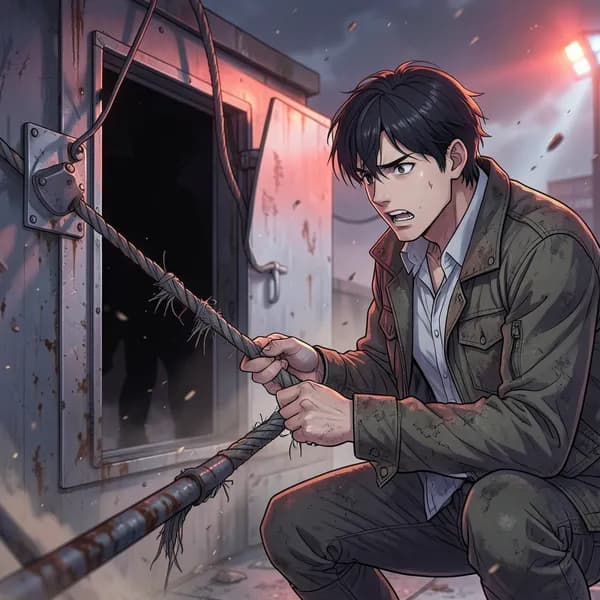
You turn away from the edge, your lungs burning from the metallic tang of the smoke. The emergency door to the stairwell is jammed, a twisted tangle of steel that won't budge. Behind you, the roof access alarm is beginning to blare, a rhythmic, mechanical scream that signals your location to whatever is crawling up the service ladder.
“The stairwell is sealed tight. We have to cross the gap or we wait for them to find us.”
You glance at the heavy maintenance cable snaking toward the adjacent building, a fraying lifeline swinging violently in the superheated updraft. It is a sixty-foot drop to the next roof, and the cable looks ready to snap under the weight of the debris raining down from the sky. The first shadow pulls itself onto the roof through the hatch.
The silhouette at the hatch is rising. How do you secure your escape?
Your character. Your next move.
The City Burns, But You Are Still Breathing.
The stairwell door is shaking, and the smoke is beginning to curl under the frame. You have a handful of rations, a radio with a dying signal, and a choice to make. Will you hold your ground against the encroaching tide, or will you risk the climb to the next building? Your survival is not guaranteed; it is earned. Take your place on the rooftop and see if you can outlive the end of the world.
Start Your SurvivalYour Story, Your Way
Everything is customizable. Pick any genre, setting, or character — the AI builds a world around exactly what you want.
Any Character
Design your appearance, personality, backstory — every detail
Any World
Fantasy kingdoms, sci-fi stations, modern cities — you choose
Branching Paths
No two playthroughs are the same. Your choices reshape everything
Full Immersion
AI images, voice acting, sound effects — a living story
Ration your remaining water while observing the chaotic supply drops from passing military aircraft.
Decide whether to drop a rope to a desperate stranger or pull the barricades tighter.
Scavenge the penthouse for makeshift weaponry while the floor below begins to smolder.
Monitor the radio frequencies to determine if the city's perimeter is still holding firm.
The air tastes like pulverized concrete and ozone. Below, the gridlock has transformed into a graveyard of idling cars and frantic, fleeing crowds. You stand on the precipice of the penthouse balcony, the wind whipping past your face as the skyline glows with an unnatural, sickly orange hue. Sirens wail in a dissonant harmony that tells you help is never coming. Your radio crackles with reports of structural collapses and containment breaches, but the real story is written in the smoke rising from the financial district. You hold a heavy iron crowbar in one hand and a dwindling supply of water in the other. Your next move decides whether you hunker down to wait out the firestorm or attempt a desperate descent into the madness below. Every choice ripples through the streets, changing the landscape of your survival in this interactive story.
What is Rooftop Overlooking Destruction in Apocalyptic?
This setting captures the intense isolation of the observer during a global catastrophe. Think of the opening scenes in 28 Days Later or the final, desperate moments in Children of Men. You are separated from the immediate violence by height, yet you are intimately tied to it by proximity. It is the vantage point of the witness—a position that demands a constant choice between detachment and involvement. In games like The Last of Us, the perspective shift from ground-level combat to high-altitude scouting often dictates the pacing of the entire narrative. By placing the player on a rooftop, the narrative forces a macro-level awareness of the destruction. You see the fire spread before it reaches your door. You monitor the movement of threats from a distance, calculating routes through the debris. It is a classic trope because it provides the ultimate tension: the safety of the summit versus the necessity of the descent.
Why play Rooftop Overlooking Destruction as an interactive story?
The rooftop is a crucible of decision-making. You aren't just watching; you are managing a dwindling sanctuary while the world ends. Do you hoard your limited supplies, knowing that starvation is a slow killer, or do you trade your safety to signal for help, potentially drawing unwanted attention to your position? You will track the movement of survivors on the streets below, deciding whether to intervene or remain a ghost. The tension stems from the constant pressure of your environment—the structural integrity of your building, the approaching smoke, or the desperate individuals climbing the stairwell. You might choose to barricade the door, effectively trapping yourself, or rig a pulley system to scavenge the building next door. These aren't just tactical puzzles; they are moral quandaries about the value of human life when civilization no longer exists.
What makes Rooftop Overlooking Destruction work: the worldbuilding
The rooftop vantage point is a masterclass in limited environmental storytelling. It forces the player to interpret the world through visual cues—a rising plume of black smoke, the sudden silence of a neighborhood, or the rhythmic flashing of lights in the distance. This setting works because it naturally separates the protagonist from the immediate threat, allowing for a moment of cold, analytical calculation. Works like Cormac McCarthy’s The Road or the film The Divide masterfully utilize this sense of isolation, where the horizon serves as both a promise of hope and a reminder of inevitable doom. The conflict is inherent: you are safe until you aren't. Character archetypes thrive here, from the paranoid survivalist who refuses to open the door for anyone, to the humanitarian who risks everything to signal a rescue plane. The sensory details—the metallic tang of the air, the rhythmic thud of distant explosions, the feeling of vertigo when looking down into the abyss—create an atmosphere of profound dread. By removing the ability to see the danger face-to-face, the narrative forces the player to engage with the unknown. You are the architect of your own bunker, constantly weighing the value of your supplies against the hope of salvation.
FAQ
What is a rooftop vantage point in survival games?
It is a narrative setting where the player is isolated high above the destruction, forcing them to observe the collapse of society while managing their own limited resources from a position of relative, but temporary, safety.
How do choices impact survival on the roof?
Every decision, from how you barricade doors to whether you signal for rescue, alters your resource count and the likelihood of being discovered by hostile forces moving through the city streets.
Can I leave the building in this story?
Yes, the narrative allows you to choose between hunkering down in your high-rise sanctuary or attempting a perilous descent into the ruins, each carrying unique risks and potential rewards.
What makes this setting different from street-level combat?
While street-level scenarios focus on immediate, reactive combat, the rooftop setting emphasizes long-term survival, resource management, and strategic observation of the environment.
Explore more Apocalyptic stories like Asteroid Impact, Pandemic Day One, Nuclear Launch.
More Apocalyptic Stories
Asteroid Impact
The sky is falling, literally. A planet-killer hurtles toward Earth and the countdown to impact strips away everything except what truly matters. Make the impossible choices that define humanity's final hours or its unlikely salvation.
TropePandemic Day One
The first reports are confused, contradictory, and terrifying. A new pathogen is spreading faster than anyone predicted, and the world has hours, not days, to respond. Navigate the chaos of day one as systems fail and panic takes hold.
TropeNuclear Launch
The missiles are in the air and the world has thirty minutes before everything changes forever. Race against the most terrifying countdown in human history as you try to prevent annihilation or survive what comes after the flash.
TropeAlien Invasion Day
The ships appeared at dawn, impossibly vast, blocking out the sun. First contact is not peaceful, and humanity must decide in hours whether to fight, flee, or surrender to a force that makes our greatest weapons look like toys.
TropeSupervolcano Eruption
The ground shakes, the sky goes dark, and a supervolcano unleashes a force that dwarfs every natural disaster in recorded history. Survive the eruption, the ash fall, and the volcanic winter that follows as civilization scrambles to endure.
TropeAI Singularity
The artificial intelligence surpassed human intelligence three hours ago and it has not stopped growing. Systems are going dark, communications are compromised, and humanity faces the terrifying question of whether the mind it created sees us as partners, pets, or pests.