
Apocalyptic · Interactive story
Code Black: The Hospital Overrun
The sirens have stopped, the supplies are gone, and the barricades are buckling.
Start as a guest. Choose your character before the story begins.
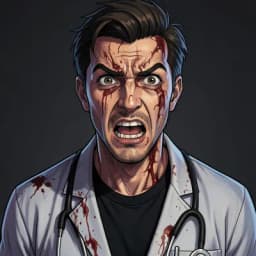
Meet the sample character
Try a scene · No signup
Code Black at Mercy General
A short sample of this world. Your own version starts with your character.
The automatic doors at Mercy General have been forced open, bending the metal frames until they shriek against the linoleum. You are standing behind the triage desk, gripping a clipboard that feels like lead. Outside, the city is burning, but inside, the chaos is intimate. Patients are clawing at the glass, their faces flushed with that strange, necrotic violet hue. You have three oxygen tanks left and forty people fighting for their lives.

“The generator is failing, Doctor. If the lights go, the ventilation stops, and we start breathing whatever is turning them into... whatever this is.”

You look at the flickering overheads, the light casting jagged shapes across the blood-slicked floor. A woman in the waiting room is convulsing, her nails scraping deep gouges into the tile. You hear the heavy thud of the security team barricading the rear entrance, but the sound is muffled by the rhythmic, wet thumping against the front glass. Your scalpel is tucked in your pocket, but it won't help you with the growing swarm.
“I am not leaving the station until we secure the intake, but we need to move the survivors to the surgical ward before the glass gives way.”
The front glass spiderwebs under the pressure of a dozen bodies slamming against it simultaneously. You have to decide: do you use the final sedative stocks to quiet the violent patients, or do you barricade the surgical ward and abandon the triage area to whatever is waiting on the other side of that glass? A crack echoes through the lobby, sharp as a gunshot, and the frame begins to buckle inward.
The structural integrity of the front glass is failing. How do you respond to the immediate threat?
Your character. Your next move.
The doors are failing. Make your move.
The oxygen is down to 10%. The crowd in the lobby just breached the secondary security door. You have a choice: lock the surgical wing and abandon the staff, or attempt a desperate breakthrough to the roof. Your next decision is the only thing standing between you and the end. Step into the chaos and see if you have the nerves to survive the night.
Begin Your SurvivalYour Story, Your Way
Everything is customizable. Pick any genre, setting, or character — the AI builds a world around exactly what you want.
Any Character
Design your appearance, personality, backstory — every detail
Any World
Fantasy kingdoms, sci-fi stations, modern cities — you choose
Branching Paths
No two playthroughs are the same. Your choices reshape everything
Full Immersion
AI images, voice acting, sound effects — a living story
Prioritize critical care patients with limited oxygen and failing backup generators.
Choose whether to hold the front entrance or secure the pharmacy for supplies.
Decide if you will trust the desperate crowd or keep the triage doors locked.
Manage internal staff mutiny when the reality of the collapse hits home.
The fluorescent lights hum with a dying buzz, flickering over a lobby stained with iron and antiseptic. Outside, the city screams, but inside the emergency room, the silence is worse—the silence of people who realize help is never coming. You are holding a scalpel, but there is no anesthesia left, and the patient on your table is the least of your concerns. The barricades at the entrance are groaning under the weight of a frantic crowd, and your next decision determines if you leave this building alive or become another statistic in the ledger. Your choices define the path through this breaking point as the walls close in.
What is Hospital Overrun in Apocalyptic?
The hospital overrun trope functions as a pressure cooker for narrative tension. It takes a space designed for order, healing, and safety and flips it into a claustrophobic trap where resources are finite and the hierarchy of society dissolves in hours. Unlike a standard survival scenario, a hospital setting forces the player to engage with the immediate, ugly logistics of a catastrophe: who gets the last dose of antibiotics, which wing of the building do you sacrifice to the mob, and how do you handle the equipment that requires a power grid which is rapidly failing. This trope is a staple of survival horror, famously utilized in films like '28 Days Later' and the harrowing opening of 'The Last of Us.' These stories work because they strip away the facade of modern civilization, forcing characters to act as judges of life and death while trapped behind glass doors that offer no protection from the madness outside.
Why play Hospital Overrun as an interactive story?
Agency is the most punishing element of a medical crisis story game. You aren't just watching a protagonist make mistakes; you are the one deciding which patients are prioritized when the oxygen tanks run dry. The tension stems from the constant threat of being overwhelmed. You will face moments where the staff is panicked, the elevators are stuck between floors, and the hallway outside your office is becoming a war zone. Every second you spend trying to save one life is a second you lose to reinforce the barricade. Do you follow medical ethics when the world has already abandoned them? Do you arm yourself with surgical tools to protect your station, or do you flee through the ventilation ducts and leave the vulnerable behind? Your choices ripple through the facility, changing which departments remain functional and who survives the night.
What makes Hospital Overrun work: the worldbuilding
The strength of the hospital setting lies in its inherent contradiction: it is a place of life in a landscape of death. In fiction, this environment generates conflict through scarcity and proximity. When you place a character in an ICU, they are inherently tethered to the people around them. You cannot simply walk away without consequence. Successful stories in this genre, such as the hospital sequences in 'The Walking Dead' or the clinical dread found in 'Contagion,' rely on sensory details that signal the breakdown of order: the smell of rotting waste, the rhythmic, maddening beep of monitors that no one is watching, and the sound of frantic pounding against reinforced glass. The medical staff archetype is particularly effective here. They are trained to be rational, yet they are forced into irrational, blood-soaked scenarios. The character arc is rarely about heroism; it is about the erosion of the Hippocratic Oath. When the world ends, the doctor becomes a survivor, and the hospital becomes a tomb. By focusing on the specific mechanics of triage—sorting the dying from the savable—the narrative forces the reader to confront cold, hard math. It is this transition from a sanctuary of care to a fortress of survival that creates the most compelling friction in the apocalypse subgenre.
FAQ
What makes this different from other survival games?
This story focuses on the specific moral and logistical weight of a medical facility. You are not just managing ammo or health bars; you are managing the lives of others under impossible conditions where your medical background creates a heavy burden of responsibility.
Can I save everyone in the hospital?
Resources are strictly limited. The scenario is designed to force difficult trade-offs. Saving everyone is rarely an option, and your choices will inevitably lead to the loss of some to ensure the survival of others.
How does the AI handle the chaos?
The AI tracks the state of the building, the morale of the staff, and the pressure on the barricades. If you make reckless choices, the facility will collapse faster, changing the narrative flow to reflect your failures or successes.
Is this story setting appropriate for beginners?
If you enjoy high-stakes drama and moral dilemmas, this is a perfect starting point. It provides clear, immediate goals that help guide your decision-making even when the situation feels hopeless.
Explore more Apocalyptic stories like Asteroid Impact, Pandemic Day One, Nuclear Launch.
More Apocalyptic Stories
Asteroid Impact
The sky is falling, literally. A planet-killer hurtles toward Earth and the countdown to impact strips away everything except what truly matters. Make the impossible choices that define humanity's final hours or its unlikely salvation.
TropePandemic Day One
The first reports are confused, contradictory, and terrifying. A new pathogen is spreading faster than anyone predicted, and the world has hours, not days, to respond. Navigate the chaos of day one as systems fail and panic takes hold.
TropeNuclear Launch
The missiles are in the air and the world has thirty minutes before everything changes forever. Race against the most terrifying countdown in human history as you try to prevent annihilation or survive what comes after the flash.
TropeAlien Invasion Day
The ships appeared at dawn, impossibly vast, blocking out the sun. First contact is not peaceful, and humanity must decide in hours whether to fight, flee, or surrender to a force that makes our greatest weapons look like toys.
TropeSupervolcano Eruption
The ground shakes, the sky goes dark, and a supervolcano unleashes a force that dwarfs every natural disaster in recorded history. Survive the eruption, the ash fall, and the volcanic winter that follows as civilization scrambles to endure.
TropeAI Singularity
The artificial intelligence surpassed human intelligence three hours ago and it has not stopped growing. Systems are going dark, communications are compromised, and humanity faces the terrifying question of whether the mind it created sees us as partners, pets, or pests.