
African Mythology · Interactive story
Many Faces, One Soul: The Shape-Shifter’s Path
One skin is never enough when the wind whispers secrets only the leopard hears.
Start as a guest. Choose your character before the story begins.
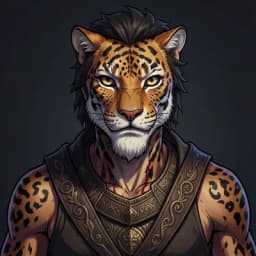
Meet the sample character
Before you can walk as a man, you must first survive the hunger of the beast.
Try a scene · No signup
The Skin That Doesn't Fit
A short sample of this world. Your own version starts with your character.
You crouch in the tall grass, your muscles rippling under fur that isn't yours. The leopard’s hunger gnaws at your belly, a sharp, golden ache that commands you to hunt. You watch the village gates, where the embers of the communal fire cast long, dancing shadows against the mud-brick walls.

“I smell the scent of the forest on the wind, something that hasn't walked on two legs in a very long time.”

You stiffen, your whiskers twitching as the Elder’s gaze sweeps over the brush. You try to recall the shape of your own hands, the way they gripped a wooden bowl or held a lover's palm, but the memory is like gray smoke in a gale. Your mind is fraying at the edges.
“I am merely a traveler who has lost his way and his patience for these riddles.”
The Elder steps forward, clutching a bowl of crushed kola nut. He knows the scent of beast, and he knows the trick of the shifting skin. If you do not change now, the jagged iron spear in his hand will find your heart. If you change, you might lose the last fragment of your human mind to the hunger forever.
The Elder raises the spear, his eyes locking onto yours with supernatural intent. How will you escape his judgment?
Your character. Your next move.
Will you remain human, or embrace the wild?
The savanna awaits your first shift. Will you use your leopard claws to defend your kin, or will you fly above the village as a bird, observing secrets that were never meant for human eyes? Your choices are the ink with which this legend is written.
Begin your transformationYour Story, Your Way
Everything is customizable. Pick any genre, setting, or character — the AI builds a world around exactly what you want.
Any Character
Design your appearance, personality, backstory — every detail
Any World
Fantasy kingdoms, sci-fi stations, modern cities — you choose
Branching Paths
No two playthroughs are the same. Your choices reshape everything
Full Immersion
AI images, voice acting, sound effects — a living story
Select your current form to influence how NPCs react to your presence.
Manage the cost of shifting, balancing your human essence against animal instincts.
Navigate complex moral dilemmas where the best choice requires losing your human voice.
Uncover hidden paths in the savanna that are only accessible while in bird form.
The scent of rain hits the savanna, and for a heartbeat, your human skin feels tight, restricted. You focus on the sleek, spotted hide of the leopard, the shift rippling through your bones like water over river stones. By the time the moon rises, you are not the person who started the day. Every choice you make in these stories ripples through the village and the spirit world alike. Do you keep your human form to negotiate with the village elders, or do you take to the skies as a hawk to scout the enemy encampment? Your decisions dictate whether you remain a guardian of the traditions or drift into the shadow of the trickster. This is an interactive story where your choices determine the fate of the land and the stability of your own identity.
What is The Shape-Shifter in African Mythology?
In African folklore, the shape-shifter is rarely just a monster or a hero; they are a bridge between worlds. Think of the stories of Anansi, who frequently assumes the form of a spider to outwit those stronger than himself, or the legends of the Ninki Nanka in West African tales, a creature whose shifting nature keeps the swampy depths alive with mystery. Unlike many Western traditions, which often frame the shift as a curse, African mythology frequently treats the ability to change form as a manifestation of extreme wisdom or supernatural alignment. It represents the fluidity of identity and the power to perceive reality from multiple perspectives. Characters like the ones found in Nnedi Okorafor’s 'Akata Witch' or the classic tales of the Yoruba trickster Eshu demonstrate that being a shape-shifter is about mastering the environment. You aren't just wearing a mask; you are gaining the instincts, the speed, and the hidden knowledge of the creature you become.
Why play The Shape-Shifter as an interactive story?
Playing as a shape-shifter forces you to balance your humanity against the primal urges of the beast. You are not just choosing dialogue options; you are choosing your physical state and its inherent limitations. If you choose to approach a diplomatic meeting as a lion, you might intimidate your rivals, but you lose the ability to speak clearly. If you travel as a bird, you cover ground quickly, but you become vulnerable to the talons of the sky. The tension lies in the forgetting. The more time you spend in the skin of a leopard, the more the human concerns of your family or your village start to feel like distant, unimportant echoes. You will face moments where a transformation is necessary for survival but dangerous for your soul. Will you sacrifice your human memories to gain the speed of a gazelle, or will you risk death to maintain your identity?
The psychology of The Shape-Shifter: why readers fall for this character
The shape-shifter archetype taps into a primal human desire: the wish to escape the boundaries of the self. In many cultures, we are defined by our limitations—our physical bodies, our societal roles, our pasts. The shape-shifter breaks these chains. In African mythology, this archetype is often tied to the concept of fluidity. Look at the 'Anansi' stories, where the spider is a vessel for intellect and guile, showing that size and physical strength are secondary to the mind. Contrast this with the 'Mami Wata' figures, who possess the ability to shift between human and aquatic forms, representing the duality of desire and danger. Why do we gravitate toward these characters? Because they represent the ultimate adaptability. They are the outsiders who can fit in anywhere because they are never truly anchored to one identity. This archetype forces the reader to ask: if I could become anything, what would I lose in the process? The fear inherent in this trope—that one might eventually forget how to be human—is what makes the choice to shift so heavy. It is a dance between power and loss. Whether it is the subtle shift of the trickster or the terrifying strength of the beast, the reader is drawn to the power of the unknown.
FAQ
What is the main challenge of playing a shape-shifter?
The challenge is managing the trade-offs. Every form offers unique abilities but closes off others, forcing you to prioritize immediate survival over long-term human goals.
How does the transformation impact dialogue?
Some forms prevent speech, forcing you to rely on non-verbal communication, body language, and environmental interaction to convey your intentions.
Can I stay in one form forever?
While you can hold a form for long periods, doing so risks losing your connection to your human identity, which can trigger unique story branches and character consequences.
Is this based on specific myths?
The stories draw from the rich, diverse tapestry of African mythology, including the trickster traditions and the legends of the spirits of the land and water.
Explore more African Mythology stories like Trickster Tale, Origin Story Myth, Spirit Quest.
More African Mythology Stories
Trickster Tale
Outwit gods, spirits, and fellow creatures with nothing but your cunning and a silver tongue. In the trickster's world, brute strength means nothing and the cleverest story always wins the day.
TropeOrigin Story Myth
Witness the moment the world was born, when the sky separated from the earth and the first humans walked into existence. Shape the very foundations of creation as you live through the myths that explain why things are the way they are.
TropeSpirit Quest
Cross the threshold between the mortal world and the spirit realm on a quest that will test your courage, faith, and understanding of forces beyond human comprehension. What you find there will change who you are forever.
TropeAncestor Communion
The veil thins and the voices of those who came before reach out to guide you. Commune with your ancestors to receive wisdom, warnings, and the strength of a lineage that stretches back to the beginning of time.
TropeShape-Shifting Legend
Your body is not fixed. Take the form of a leopard, an eagle, or a river serpent as you navigate a world where the boundary between human and animal is a matter of will. But every transformation comes at a cost you may not be ready to pay.
TropeDivine Punishment
You defied the gods, and now the consequences are coming. Face plagues, curses, and cosmic retribution as you search for a way to atone, or find the audacity to challenge the divine order itself.