African Mythology · Interactive story
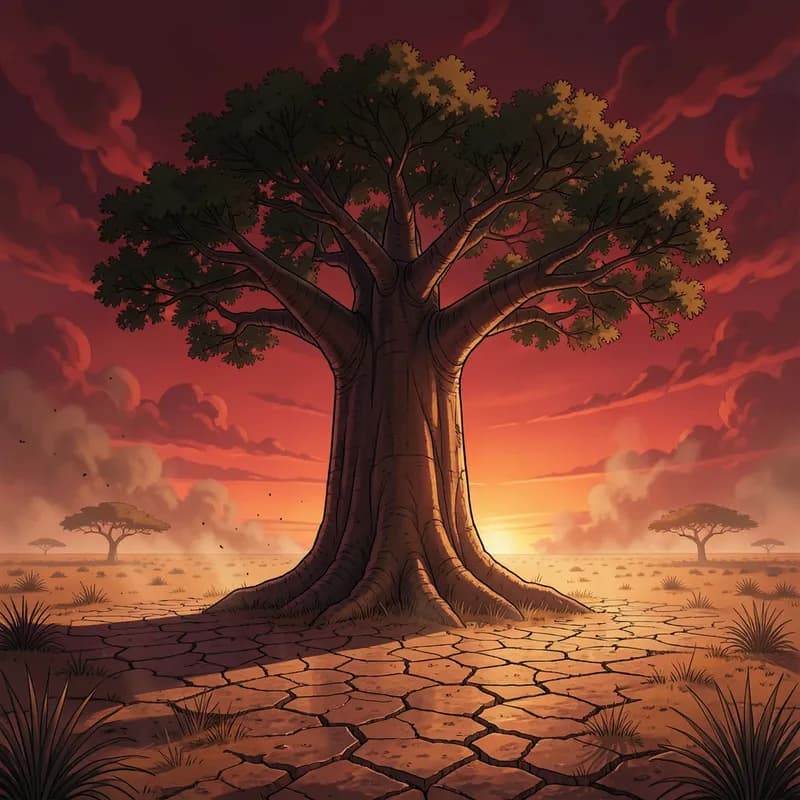
Whispers Beneath the Sacred Baobab
The roots drink from the underworld while the branches brush against the gods themselves.
Start as a guest. Choose your character before the story begins.

Meet the sample character
The roots of the ancestors grow deep, and they are thirsty.
Try a scene · No signup
The Hollow Heart of the World-Tree
A short sample of this world. Your own version starts with your character.
You press your palm against the wrinkled, grey hide of the ancient baobab. Dust coats your tongue, tasting of parched earth and long-forgotten secrets. Beneath your touch, the wood pulses—not with sap, but with the rhythmic beat of a thousand buried generations. The air thickens, turning unnaturally cold despite the desert sun, as the bark begins to pull back like a closing eye.

“You seek the rain, little leaf, but are you prepared to pay the price in blood and shadow?”

The ground trembles beneath your sandals. You pull your hand away, but the tree has already claimed your warmth. You feel the roots deep below shifting in the underworld, grinding against the bones of the ancestors. A dry wind howls through the hollow trunk, whispering names you were never meant to hear. You stand on the precipice of a choice that could wither your village or drown it in abundance.
“I came for the rain, not to bargain for the souls of those who walked before me.”
The voice within the trunk ripples with laughter, a sound like dry branches snapping in a gale. The opening widens, revealing a swirling mist that tastes of ozone and storm-clouds. From the depths, a glowing root snakes out, coiling around your ankle like a hungry serpent. If you stay, you drown; if you run, your village turns to dust by morning.
The glowing root tightens around your leg, pulling you toward the dark center of the tree. How do you respond?
Your character. Your next move.
Will you earn the tree's wisdom or its wrath?
The branches are waiting, and the spirits are listening to your every word. Step into the hollow of the Great Baobab and see if you have the cunning to outsmart the ancient ones. Your choices will decide if the cycle of the seasons continues or if the world falls into silence.
Enter the Sacred TreeYour Story, Your Way
Everything is customizable. Pick any genre, setting, or character — the AI builds a world around exactly what you want.
Any Character
Design your appearance, personality, backstory — every detail
Any World
Fantasy kingdoms, sci-fi stations, modern cities — you choose
Branching Paths
No two playthroughs are the same. Your choices reshape everything
Full Immersion
AI images, voice acting, sound effects — a living story
Select offerings for the spirits to gain forbidden knowledge hidden within the trunk.
Argue your case before an council of gods to change the fate of your village.
Navigate the shifting paths inside the tree to outsmart a vengeful shadow entity.
Decide whether to preserve an ancient secret or share it to save a friend.
The bark of the Great Baobab is thick as a mountain, scarred by the fingernails of spirits who climbed it when the earth was still cooling. Zola presses her palm against the wood, feeling a pulse that matches no living heart. She has come to ask for a favor, but the tree does not give secrets for free. Here, every decision leaves a mark. Whether you walk with the grace of a leopard or the sly cunning of a spider, the choices you make within this hollow trunk rewrite the songs of the ancestors. The air grows heavy with the scent of dry earth and impending rain as the spirits wait for you to speak your intent. Will you bargain for power, or will you offer a memory to satisfy the hunger of the roots? Your path is yours to carve, provided you can survive the truth waiting in the shadows of the boughs.
What is the Sacred Baobab Tree in African Mythology?
In many cultures across the continent, the baobab is not merely a tree; it is a gateway, a courthouse, and a living record of history. Often called the 'upside-down tree' because its branches resemble roots reaching toward the heavens, it serves as a central pillar in folklore. In stories like those found in Nnedi Okorafor’s 'Akata Witch' or the traditional tales of Anansi the Spider, the tree functions as a transition point between the physical realm and the dwelling place of deities. It is a place where village elders once sat to judge disputes, and where spirits are said to gather when the moon is hidden. Unlike the stoic oaks of European folklore, the baobab is porous and alive with a trickster-like energy. It demands respect, for its hollows hold the voices of those who came before. It is a setting where the laws of physics bend to the weight of ancient magic, making it a perfect anchor for tales of gods, humans, and the thin line separating them.
Why play a Sacred Baobab Tree interactive story?
Agency is a dangerous tool when dealing with spirits who view time as a circle rather than a line. When you step into this setting, you are not merely observing a myth; you are testing your own wit against the ancient traps set by the forest. You might find yourself negotiating with a sky deity for the return of a stolen season, or deciding whether to trust the advice of a spider who claims to have your best interests at heart. The tension lies in the ambiguity of your choices. A polite gesture might be interpreted as an insult by a vengeful spirit, while a bold act of defiance could earn you the favor of the earth itself. You decide how to approach the hollows, how to interpret the rustle of leaves, and how to face the consequences when the tree decides it has heard enough. Every interaction is a gamble, and the stakes are the legends themselves.
What makes the Sacred Baobab Tree work: the worldbuilding
The power of the baobab as a narrative setting lies in its inherent duality. It is simultaneously a sanctuary and a trap. In Tomi Adeyemi’s 'Children of Blood and Bone,' the connection to the ancestral realm underscores the importance of heritage; the baobab reflects this by grounding every story in the weight of generations. To write effectively within this space, one must prioritize sensory details: the grit of dust, the vibration of low drums, and the sudden silence that falls when a deity is present. The primary conflict in this setting should always be a clash of perspectives—the pragmatic human versus the capricious spirit. Characters who thrive here are those who understand that in African mythology, humor and tragedy often walk hand-in-hand. Tricksters like Anansi or Eshu are common, bringing a necessary unpredictability that keeps the narrative from becoming stagnant. By referencing the oral tradition, where the storyteller controls the rhythm, this setting allows for a recursive, non-linear progression. The tree itself acts as a character, reacting to the player's moral alignment and past actions. It remembers your failures just as clearly as your triumphs, forcing you to reconcile with the ghosts you have created along the way.
FAQ
What makes the Sacred Baobab different from a standard forest setting?
A standard forest is a collection of trees, but the Sacred Baobab is a singular entity with its own consciousness. It acts as a bridge between the physical and spiritual worlds, meaning the rules of reality—such as distance, time, and causality—often function differently within its reach.
Can I play as a god in these stories?
While you often interact with gods, you typically play as a mortal trying to survive or thrive within their sphere. This creates a more compelling dynamic, as you must use your wits and cultural wisdom to negotiate with entities that possess far more power than you.
How does the trickster element affect my choices?
Tricksters in this mythology are agents of chaos who value cleverness over brute strength. If you choose to engage with them, expect your decisions to have unintended, often humorous or paradoxical, consequences that force you to think several steps ahead.
Is this setting suitable for high-stakes drama?
Absolutely. The baobab is the site of ancient councils and foundational myths. The consequences of your actions can ripple outward to affect entire kingdoms or the balance between the sky and the earth, ensuring that every choice carries significant weight.
Explore more African Mythology stories like Trickster Tale, Origin Story Myth, Spirit Quest.
More African Mythology Stories
Trickster Tale
Outwit gods, spirits, and fellow creatures with nothing but your cunning and a silver tongue. In the trickster's world, brute strength means nothing and the cleverest story always wins the day.
TropeOrigin Story Myth
Witness the moment the world was born, when the sky separated from the earth and the first humans walked into existence. Shape the very foundations of creation as you live through the myths that explain why things are the way they are.
TropeSpirit Quest
Cross the threshold between the mortal world and the spirit realm on a quest that will test your courage, faith, and understanding of forces beyond human comprehension. What you find there will change who you are forever.
TropeAncestor Communion
The veil thins and the voices of those who came before reach out to guide you. Commune with your ancestors to receive wisdom, warnings, and the strength of a lineage that stretches back to the beginning of time.
TropeShape-Shifting Legend
Your body is not fixed. Take the form of a leopard, an eagle, or a river serpent as you navigate a world where the boundary between human and animal is a matter of will. But every transformation comes at a cost you may not be ready to pay.
TropeDivine Punishment
You defied the gods, and now the consequences are coming. Face plagues, curses, and cosmic retribution as you search for a way to atone, or find the audacity to challenge the divine order itself.